
Yala National Park is a 400 square kilometer preserve set in the dry lowlands of Sri Lanka. Consisting of tall stone monoliths, endless pristine beaches, verdant scrub jungle and freshwater lagoons, this park is world-famous for its leopards. No other place on Earth has a higher density of these spotted cats (2/square kilometer!) It is also home to 215 bird species, 44 additional mammal species and high quantities of reptiles and amphibians. My family and I travelled to Sri Lanka in December of 2017, and spent 2 days in Yala, embarking on three safaris into the park’s heartlands in search of big game. We ended up seeing over 30 bird species (including 23 lifers) and 12 mammal species! Outside of our 2019 trip to Sabi Sands Game Reserve in South Africa, this was probably one of the most rewarding wildlife ecotrips i’ve taken thus far.


Our first safari took place in the afternoon. Luckily, the usual barrage of tourists and jeeps omnipresent in the park wasn’t with us today.
As we sped toward the park’s entrance, we saw several notable species including Yellow-Billed Babblers, Spotted Doves, Oriental Magpie-Robins, a Common Myna and sounders of Wild Boar. As we waited for our jeep to be registered for park entry, we saw a herd of pretty Axis Deer does and a lone Wild Boar sow (female).


Once we got registered, we drove into the park and came across a lone Feral Water Buffalo in a waterhole, along with several Yellow-Wattled Lapwings on the nearby embankment, and some colourful Green Bee-Eaters in a nearby tree.


We also saw a lone Blue-Tailed Bee-Eater flying away into the distance, and a herd of Axis Deer including several males equipped with full racks of antlers near the waterhole containing the buffalo, which proved a cool sight.

We moved on to one of the park’s famous freshwater lagoons, or tanks, a striking landscape where lotus flowers carpet the water’s surface and dead trees poke up like toothpicks from the depths. These water bodies were actually ancient irrigation reservoirs built in the 12th century to provide water to nearby rice fields. In the modern day, they are important habitats to big game and migratory waterfowl. We saw a Painted Stork, a flock of Lesser Whistling Ducks, and a Little Egret as we drove by.


A single Mugger Crocodile basked in the tropical sun on the bank of the lagoon, providing a nice photograph and a good chance for us to observe the semi-aquatic toothy carnivore on dry land.

Around an hour into our safari, we entered the lush scrub-jungle of the park, the haunt of Leopards, Asian Elephants and Sloth Bears. The forest was thick and thorny and was almost a greener reminiscent of the African bushveld, now that I compare the two.

On the side of the jeep track, we observed a rare Indian Star Tortoise.

A few minutes later, a lone Bengal Monitor walked right across the road in front of us, one of several monitor lizards we saw that day.

We saw some Little Swifts, a Maritime Striped Squirrel and a single bright-colored Red-backed Flameback perched on the trunk of a faraway tree, our first endemic bird species of the trip. Around fifteen minutes after we saw the monitor lizard, our driver pointed out an Indian Peafowl in a distant tree, a lifer for me and a bucket list species as well!

We came to an interesting rock formation where our driver spotted a juvenile Changeable Hawk-Eagle in a nearby tree. It was quite a majestic animal and stuck around long enough for us to take some nice photos.


Around twenty minutes after seeing the hawk-eagle, we found our second endemic species of the trip- the Ceylon Junglefowl, rustling in the brush about fifteen meters from where we were. These birds are basically indistinguishable from domestic roosters apart from the yellow markings on their fleshy combs but are still really cool to see in the wild!


We came to a clearing where a herd of Axis Deer moved briskly through the trees, and where a mother Feral Water Buffalo was helping her newborn calf up.

We saw a single Black-Naped Hare at this clearing, which actually came close to our jeep, providing a close-up picture.

About two and a half hours into our safari, we pulled over to the bathrooms to stretch our legs before embarking to try and find a leopard or elephant before the park closed. There was quite a lot of animal life in the area, and I did a little nature walk to see what I could find. In the water body around the bathrooms was a juvenile Lesser Adjutant, foraging for fish and a perched Common Kingfisher.


In the trees above and on the ground in front of me, the two species of monkeys found in Yala made an appearance. The first was the endangered Toque Macaque, an endemic to Sri Lanka.


The second monkey species was the shy Tufted Gray Langur.

Upon entering our jeep, we got a call about a subadult elephant not far from where we were! Racing to the area, we got an amazing view of this majestic creature– our first and only Asian Elephant of the day.

Satisfied with our first safari in Yala, we departed the park. Our last animal of the day was this Yellow Bittern, which we saw near our hotel.

We then relaxed for the remainder of the day. The next day we got up bright and early, ready for our second safari. After leaving our bungalow at around 5:00 A.M, we sped down the dark road through Tissa, until pavement was replaced by dusty, dirt roads leading to Yala Block 1. Unfortunately, our no-tourists gig from the day before didn’t extent to today. There was a line of jeeps waiting to enter the park.

We saw a lone elephant as we were waiting to enter the park, marking our first animal of the day.

The early morning light illuminated some beautiful lagoons.


Shortly after sunrise, we were treated to a peacock displaying to a peahen, and next to a lagoon we saw some Black-Headed Ibises, Eurasian Spoonbills, an Asian Openbill and an Intermediate Egret.


After making the (smart) call in asking our driver to stray away from the touristy areas, we ended up experiencing a more wild Yala altogether. Some animals we saw at a remote waterhole include an elephant and some wallowing Feral Water Buffaloes.


A Ruddy Mongoose stalked into the grass nearby, allowing for us to photograph it before it disappeared.

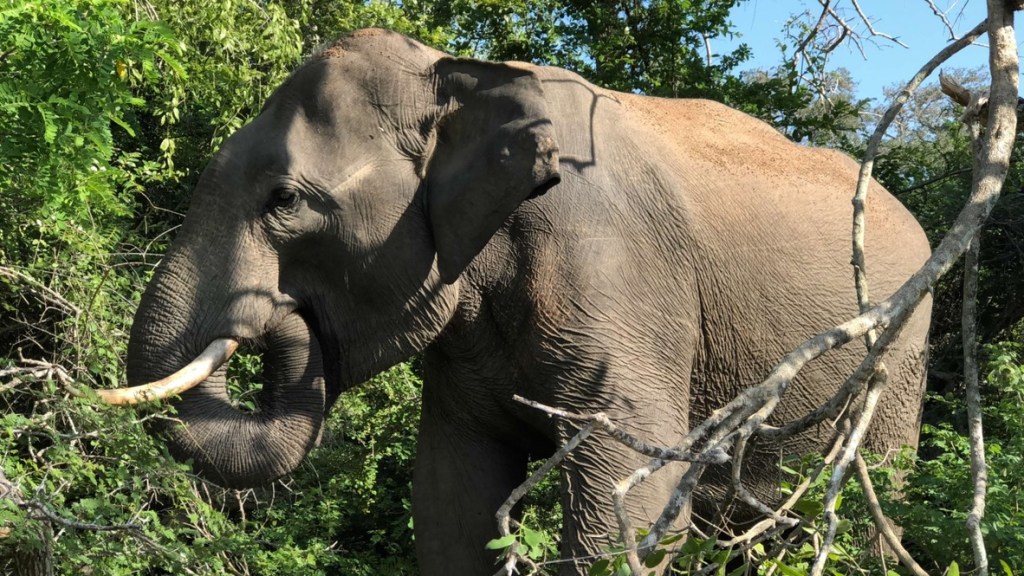
As we continued along the track, we came to a riverbed with a very lucky surprise for us- a tusker male Asian Elephant! Only around 10 exist within Yala and seeing one is a matter of complete luck which was on our side today. In general, tusks are exceedingly rare on even male Asian Elephants in Sri Lanka, and are absent on females. He made for some excellent photos as he fed!


After this spectacular sighting, we got a call about a leopard 15 minutes from our location. We sped toward the feline but all we saw was a huge line of tourist hoping for the same query as us. Despite this disappointment, we did, however, see some really interesting Brown Fish Owls in a faraway tree that our driver pointed out to us, and a monitor lizard that slinked away through the bushes.


Afterwards, we did some more relaxed birdwatching away from the tourists and saw some beautiful birds including Baya Weavers, some more Green Bee-Eaters, Orange-Breasted Green Pigeons, an adult Lesser Adjutant and Malabar Pied Hornbills. As we ventured deeper into the scrub jungle we saw a herd of female Asian Elephants and their young! We got to watch them feed for almost half an hour.


We departed the reserve afterwards and rested for several hours at our hotel before embarking on our final safari in the park. We were are extremely hopeful about seeing a leopard which had managed to elude us on our previous two safaris. Our driver brought us to a different, less touristy part of Yala for this safari, near Galge Bend. On the way, we saw a Grizzled Indian Squirrel and some Indian Flying Foxes high above. After entering the park for the final time, we began searching for leopards.


Our driver found leopard tracks from the morning in some soft sand, but they disappeared into the undergrowth and were impossible to follow. It gave us hope, though!

We continued on to the windswept Wehragala Reservoir where we decided to do some birdwatching as this particular area was known for it.

We saw some really cool birds, many of them lifers, along the reservoir’s dam. Soaring above us were some Brahminy Kites

Next, we saw some Rose-Ringed Parakeets on a dead branch quite far away from us, but proved an interesting sighting nonetheless.


The last bird we saw on the dam was possibly the most beautiful bird we saw during our entire time at Yala, with iridescent dark blue and indigo wings, it looked almost like a painting come to life! The Indian Roller is truly a spectacular bird.


As we headed back into the scrub jungle, we noticed several animals, including Red-Wattled Lapwings, an Indian Peafowl which came very close to our jeep, and a lone Wild Boar.


As we were watching the peacock, we got a call about a leopard very close to where we were! After rushing toward the area, we saw the Leopard in a pocket of dense thorns where it rested. Many jeeps had arrived to witness the cat. The leopard disappeared into the dense undergrowth after several minutes. We continued to hear the alarm calls of monkeys and birds, but no leopard. As we left the area in our jeep after ten minutes of waiting, suddenly there he was again, only this time he was lapping water up from a watering hole!


Though we only saw the leopard for a short while, he was an incredible sighting nonetheless and made us very happy on our way back after leaving the park. I would totally recommend this experience to anyone visiting Sri Lanka, and I would love to come back to Yala someday. The adrenaline pumping through you as you rip through the wild in search of big game is awesome!
However, going on safari in Yala can be pricey, so make sure if you are on a budget to book ahead of time, and be careful about which company you go on safari with, as many will try to scam you. It is better to have your hotel book the jeep for you (like we did) than end up paying a ridiculous fee for an inexperienced “guide” and a driver that is careless to the animals and just wants an extra tip
Bird Species Recorded: (31 total, including 24 lifers)
Indian Peafowl (Lifer)
Ceylon Junglefowl (Lifer)
Yellow Bittern
Common Kingfisher
Painted Stork (Lifer)
Brown Fish Owl (Lifer)
Brahminy Kite (Lifer)
Changeable Hawk-Eagle (Lifer)
Red-Wattled Lapwing (Lifer)
Malabar Pied Hornbill (Lifer)
Rose-Ringed Parakeet (Lifer)
Intermediate Egret (Lifer)
Common Myna
Cattle Egret
Baya Weaver (Lifer)
Sri Lanka Flameback (Lifer)
Indian Roller (Lifer)
Lesser Whistling Duck (Lifer)
Green Bee-Eater (Lifer)
Blue-Tailed Bee-Eater (Lifer)
Asian Openbill (Lifer)
Lesser Adjutant (Lifer)
Orange-Breasted Green Pigeon (Lifer)
Spotted Dove
Oriental Magpie-Robin
Little Cormorant (Lifer)
Black-Headed Ibis (Lifer)
Yellow-Wattled Lapwing (Lifer)
House Sparrow
Little Swift (Lifer)
Yellow-Billed Babbler (Lifer)
Eurasian Spoonbill (Lifer)
Mammal Species Recorded: (12 total, including 10 lifers)
Leopard (Lifer)
Asian Elephant (Lifer)
Wild Boar
Wild/Feral Water Buffalo
Axis Deer (Lifer)
Black-Naped Hare (Lifer)
Tufted Gray Langur (Lifer)
Toque Macaque (Lifer)
Ruddy Mongoose (Lifer)
Indian Flying Fox (Lifer)
Grizzled Indian Squirrel (Lifer)
Maritime Striped Squirrel (Lifer)
 Bennett Gardner Wildlife Watching
Leave a comment