

Wildlife and wildlife conservation have always been passions of mine, but birdwatching is a relatively new hobby that I’ve picked up just this past year. Even before I became interested in birding, I was still a keen wildlife watcher and was especially interested in wild mammals. After hearing about a wetland in the New Territories around 4 years ago where creatures like Small Asian Mongooses and Leopard Cats could be found, I quickly made my first trip out there with high hopes. This is how I discovered Mai Po. While I never saw any rare mammals in the reserve (or any mammals for that matter), the abundance of unique birdlife inspired me to return at least once per year since. After taking up birdwatching recently, and after receiving my entry permit to the main areas of the reserve, I was once again filled with the same excitement that had hit me the first time I’d heard about Mai Po.

Yesterday, I had finally chosen a day where I would set off to explore the reserve’s interior. My sister decided to accompany me for the trip, and together we found over 32 bird species and trekked across almost 7 kilometers of the preserve. My sister enjoyed most of the trip (except the incessant heat), and about 15 of the birds we saw today were lifers for her: for me, only one of the bird species we saw was a lifer. Both of us were quite inspired by Mai Po’s unique landscapes and the diversity and abundance of wildlife that’s found in this 1,500 hectare piece of land. In a sense, Mai Po is Hong Kong’s lost world: a well-maintained and accessible wetland with superb wildlife viewing, sealed off to everyone except birders, researchers and government officials with permits. Apart from birding, we observed and learned about the surrounding wetland and its unique flora. Needless to say, both my sister and I are excited to return!

Before leaving my house, I noticed a Pallas’s Squirrel chewing on the scaffolding outside, something I’m not used to as I live in a 3-story high apartment. Nevertheless, he provided a pretty nice photo.

We arrived at Mai Po around 1pm. The weather was hot and muggy when we arrived, an unseasonable heat wave that is expected to bring thunderstorms later this week to Hong Kong. We looked for birds in some trees near the reserve’s entrance, finding some common species as well as two Azure-Winged Magpies.

My permit was scanned and validated by the guards at the reserve entrance, and we started up the reserve’s tree-lined main trail, which provided panoramic vistas out onto the nearby reed beds, mangroves and forests. Because I’m so used to walking on the road that surrounds Mai Po rather than the reserve proper, seeing the reserve from a trail came as quite a shock for me! Shortly after entering, we saw a small, gray-headed bird near the path, which turned out to be a Black-Faced Bunting, my only lifer of the day. It took me awhile to identify: initially I thought it was a type of pipit.

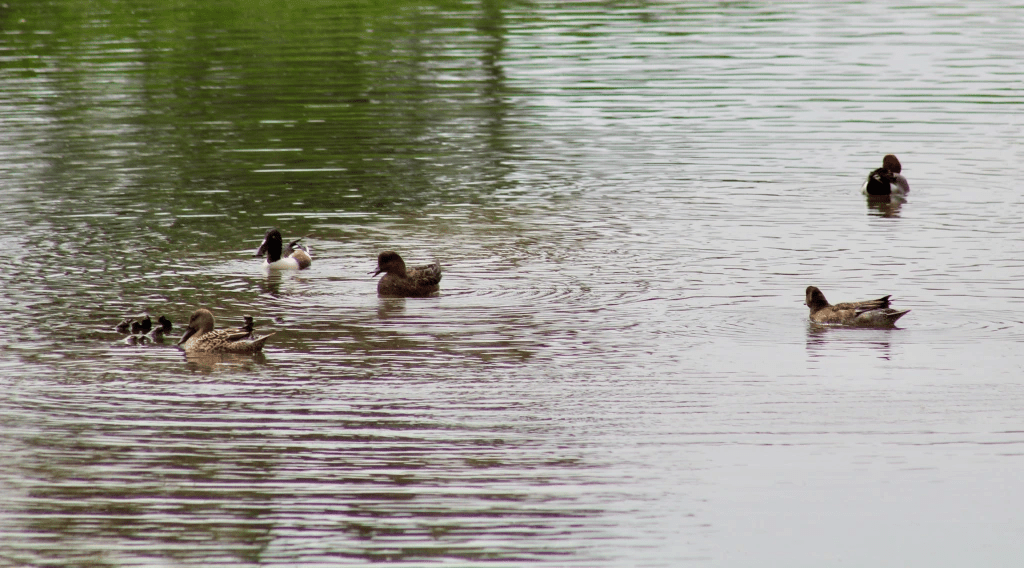
We continued on to an elevated green building called the “Tower Hide”, which provided splendid views out onto some reed beds and a marshy pond. What’s interesting is this part of the wetland was actually a grid of aquaculture ponds less than 25 years ago. It was only because of conservation efforts from the WWF and the government that this area has been converted into a wetland. It’s quite impressive what they’ve done since then. From the hide, we spotted many waders including Pruple Herons, Little Egrets, Gray Herons, Great Egrets, Black-Winged Stilts, a White-Breasted Waterhen, Northern Shovellers and Eurasian Wigeons. I must say, I was impressed when my sister started learning the names of the many birds we saw!


After about 15 minutes, I noticed a large wader with a spoon-shaped bill very far out in the pond. I instantly recognised it as one of Hong Kong’s most iconic animals, and a species I really wanted my sister to see today- the endangered Black-Faced Spoonbill. Although we saw it from a distance, the encounter was still pretty cool.

We left the Tower Hide, and continued along the main path. We saw tons of laughingthrushes and bulbuls, one very noisy Asian Koel and several Olive-Backed Pipits. I was on the lookout for both mongooses (which apparently are commonplace during the day in Mai Po), and kingfishers.


We made our way to a second, smaller hide, which also provided some views out onto the ponds and reed beds. The entire area was chock-full of every variety of wetland bird imaginable, definitely part of the appeal of Mai Po. From here, we spotted Common Greenshanks, a juvenile Chinese Pond Heron, egrets, ducks and Kentish Plovers.


It was around 2:30 pm when we left the second hide, and the sunlight really came out in full force, leaving us hot and sweaty for the remainder of the trip. After walking for probably ten minutes, we turned off the main trail and explored the nearby Mangrove Boardwalk, which was a pretty mesmerising experience. The amount of educational material throughout the reserve and especially in this particular area makes it an excellent place to learn about Hong Kong’s vitally important wetlands and the key environmental role they play. While in the mangroves, I found some Mudskippers, a species of fish that lives in brackish wetlands, and during low tide can survive without water by breathing air. Mudskippers can also move on land by jumping using their enlarged pectoral fins! We also found some Mangrove Ferns, a unique plant growing only in mangrove forests, and 3 species of mangrove trees.


The Mangrove Boardwalk let us out at a different part of the reserve, with hardened dirt paths and lush marshes. In a small channel between the mangroves and dry land, we found a secretive Little Grebe hunting for fish.


We came to a dried-out pond full of dead fish, a sad but common sight here during Hong Kong’s dry months. The pond was a Mecca to the reserve’s egret population: there must’ve been a good 40 of them feasting on the fish.


We also came upon a fenced-off area where a lone water buffalo was grazing. We later learned that the WWF was using water buffaloes to create habitats for many wetland birds: quite a unique experiment. Many Cattle Egrets could be seen in the marsh. In the distance, a pond full of Gray Herons and Great Cormorants made for some nice waterbird viewing.


We came to another boardwalk, where many different butterflies and water lily flowers could be seen. It was around 3:15 when we returned to a trail, and both of us were quite tired, so we headed back toward the main path. Along the way, we saw Black Drongos, Greater Coucals, Plain Prinias, and a female Daurian Redstart.


That pretty much sums up our first true experience in Mai Po: a very interesting look at the mangroves, reed beds, birdlife and other wildlife that make this wetland so unique. As someone who’s travelled the globe in search of wildlife with my family, I’ve seen my fair share of wetlands and wetland birds. Needless to say, I was still impressed at the quantity and diversity of birds in the reserve. Both of us are inspired to come back during the best month to bird in Mai Po, April, for hopefully even more species! Stay tuned,
-Bennett
Bird Species Recorded Today: (32 total, including 1 lifer)
Black-Faced Bunting (Lifer)
Azure-Winged Magpie
Asian Koel
Black Drongo
Little Grebe
Little Egret
Great Egret
Cattle Egret
Chinese Pond Heron
Purple Heron
Gray Heron
Black-Faced Spoonbill
Black Kite
Masked Laughingthrush
Daurian Redstart
Black-Collared Starling
Kentish Plover
Black-Winged Stilt
Eurasian Wigeon
Northern Shoveller
Crested Myna
Oriental Magpie-Robin
Spotted Dove
Chinese Bulbul
Red-Whiskered Bulbul
Great Cormorant
Eurasian Moorhen
Greater Coucal
Plain Prinia
Olive-Backed Pipit
White-Breasted Waterhen
Common Greenshank
Mammal Species Recorded: (1 total)
Pallas’s Squirrel
 Bennett Gardner Wildlife Watching
Leave a comment