
Wow! That’s all I have to say about yesterday’s birding bonanza at Mai Po. This amazing wetland gifted me 46 species in a single outing, 8 more than I’ve ever recorded in one place at one time, plus 8 lifers, over a time span of 5 hours and a walking distance of 8 miles! Today was a solo outing for me, which allowed me to be one with my surroundings and to take in more bird activity.
Before departing for my expedition, I was keen on seeing as many migratory waders as possible in one day. After reading recent posts from other local birders talking about the influx of migrants moving north through Mai Po’s extraordinary mudflats, mangroves, ponds and reed beds, I knew I couldn’t miss this valuable opportunity. The diversity of birds in April in this well-protected preserve is truly mind-boggling, which is why I cleared my schedule far in advance and set aside an entire day to try my luck birding in one of Earth’s greatest wetland reserves.
(For reference to non-birders, Mai Po is at the approximate geographical center of the East Asian Flyway, the longest avian migratory route on Earth, that stretches from Australia to Alaska. Mai Po is a crucial stopping point for birds on the flyway migrating from wintering spots in Southeast Asia toward summer sites in Siberia and Northern Asia.)

Upon arriving at around 10:30 am (the earliest I’ve ever arrived at Mai Po), I saw the usual barrage of egrets, stilts and herons near the guard post. I walked a short distance to the pond where I saw the 13 spoonbills last time, and once again I was in for a treat. 5 Red-Necked Stints, my first lifer of the day, were huddled close together near the center of the pond. Shortly after, I came to a couple of birders that had spotted a Collared Crow perched on a dead tree; a threatened species and one that’s always nice to see.


The weather was really nice, especially compared to the demoralising drizzle last time I visited. It was probably 75°F (24°C) and partly cloudy, with a moderate breeze that kept it nice and cool. This weather was unusual for the often muggy and hot spring months of Hong Kong.
As per usual, there was little bird activity in the center of the reserve besides copious amounts of egrets, some common songbirds and a few Little Grebes. While I do love this area for its bird hides and its wide, flat marshy landscapes, I wasted no time in reaching the perimeter road and making my way along the floating boardwalk. Today I was determined to find some more migratory waders.

The mangroves lining both sides of the boardwalk today were buzzing with life. Forests like Mai Po’s mangroves, are, without a doubt, one of my favorite places on Earth. They’re enormously biodiverse, crucial to humanity, and indescribably beautiful. Mai Po’s mangrove forest is the 6th-largest expanse of mangroves left anywhere in China, at 380 hectares. This makes it a crucial habitat not only to birds, but also a huge array of unique flora, invertebrates, mammals and reptiles. The feeling of walking through the mangroves is pretty awesome, with the sound of the ocean nearby, the smell of brackish mud and mangrove flowers, and an endless carpet of dense foliage stretching for miles around.

I arrived shortly after at the mudflats, deciding to try the other two bird hides (there are three total on the mudflats) that I didn’t go to last time. Over the course of the next 3 hours, I hit all 3 bird hides, with the hide I’d gone to last time yielding the best sightings. I was thoroughly impressed with the numbers and diversity of the shorebirds coming through the area, and I managed to nab 6 lifers and almost 25 species in total on the mudflats alone!
The view out from the bird hides was great, with the towering metropolis of Shenzhen, this time glistening in the afternoon sun, in the background. On the mudflats, there must’ve been several thousand birds, many of which were too far away to identify but altogether made for a pretty incredible few hours of birding! Highlights include a lone Osprey—a Hong Kong tick (I see them all the time in the US, but never before in Hong Kong). About 10 or 15 Black-Bellied Plovers, two Gull-Billed Terns, a Whimbrel, four Eurasian Curlews (a striking shorebird found throughout Eurasia and a target species of mine). Terek and Common Sandpipers, Greater Sand Plovers, and several Black-Faced Spoonbills. Needless to say, I’m definitely coming back here next time I visit Mai Po!


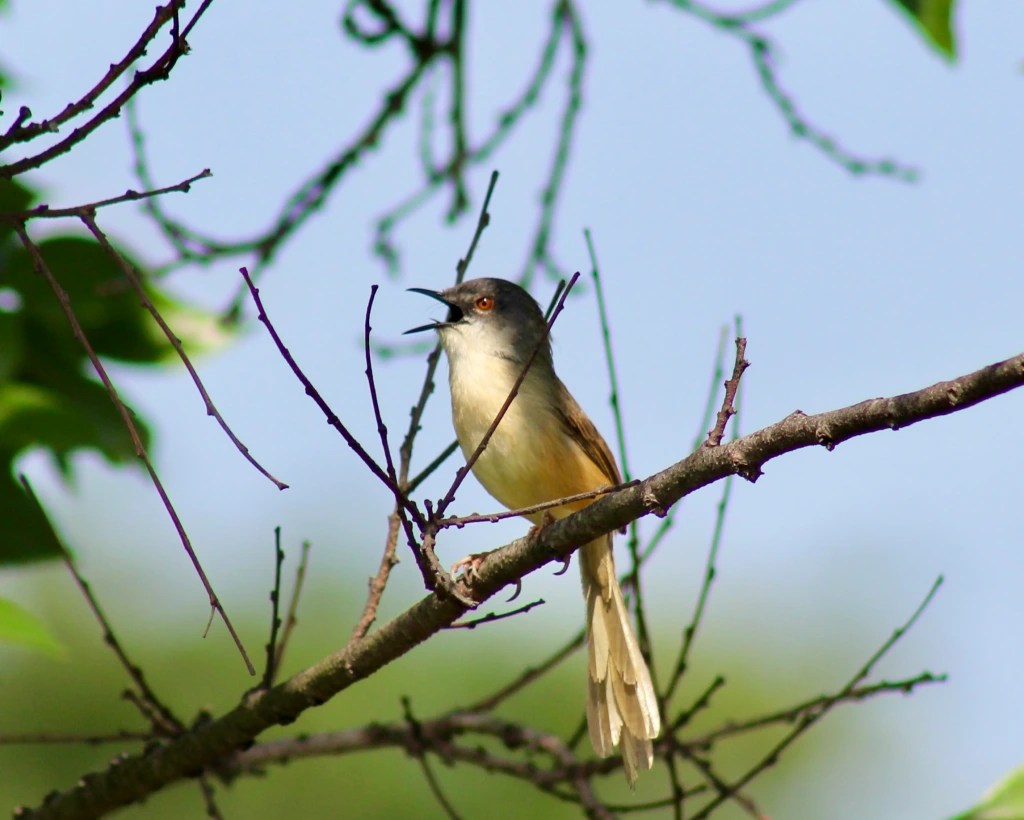
I had a really satisfying time at the mudflats, and I only left because the bird activity got quite slow after awhile. I continued along the perimeter road to an area of Mai Po I’d never seen before. It was far less populated by people than other parts of the reserve and had a more natural feeling to it, with the pavement eventually being replaced by an earthen track with tall nut trees and mangrove shrubs surrounding it. There was surprisingly little bird activity, especially when compared to the mudflats, but still some egrets and other birds could be seen. I checked out a few local hides while walking, and I found some Plain Prinias, an Eastern Yellow Wagtail, and a Common Kingfisher. Around the education center, I spotted a vocalising Yellow-Bellied Prinia, my eighth lifer of the day.


It took me about an hour to walk the 3 miles from the boardwalk to the reserve entrance by taking the perimeter road, and though I enjoyed the vistas, weather and birdlife of the area I walked through, I was quite dehydrated and needed a rest. I left Mai Po around 3:20 to look for someplace selling drinks, but I still wanted to do some birding. Since no other beverage options were available around the reserve, I was forced to walk an additional 2 miles along the road leading to the village closest to the reserve, which was surrounded by Gei Wai (shrimp) ponds, run by local villagers.
I kept my eyes peeled for birdlife, and at around 3:45pm, near the village, I saw some pretty interesting species including a Common Myna (introduced) and some Red-Billed Starlings, my eighth and final lifer of the day. I got a drink and a cab shortly after, which concluded my very long and extremely fruitful expedition to the marshes.

The abundance and diversity of birdlife in Mai Po will never cease to amaze me, and out of all the places I could choose to return to in Hong Kong as an adult, Mai Po would top the list. My Mai Po permit has opened the gates (quite literally) to a avian Garden of Eden, where 400+ species of birds and vast natural scenery can make even non-birders wish for a pair of binoculars to take it all in. I’ll definitely be back here at least once before June and I hope I can nab even more species, and beat my new personal best of 46!
Species Recorded: (46 total, including 8 lifers)
Gull-billed Tern (Lifer)
Common Sandpiper (Lifer)
Terek Sandpiper (Lifer)
Red-necked Stint (Lifer)
Eurasian Curlew (Lifer)
Black-bellied Plover (Lifer)
Red-billed Starling (Lifer)
Yellow-bellied Prinia (Lifer)
Osprey
Greater Sand Plover
Little Grebe
Black Kite
Black Drongo
Oriental Magpie-Robin
Eurasian Moorhen
Greater Coucal
Northern Shoveler
Black-faced Gull
Whimbrel
Black-winged Stilt
Pied Avocet
Plain Prinia
Masked Laughingthrush
Black-collared Starling
Red-whiskered Bulbul
Light-vented Bulbul
Japanese White-eye
Crested Myna
Common Myna
Eurasian Tree Sparrow
Spotted Dove
White Wagtail
Eastern Yellow Wagtail
Barn Swallow
Cinereous Tit
Collared Crow
Large-billed Crow
Azure-winged Magpie
Red-billed Blue Magpie
Black-faced Spoonbill
Chinese Pond Heron
Little Egret
Great Egret
Cattle Egret
Gray Heron
Common Greenshank
 Bennett Gardner Wildlife Watching
Leave a comment