
To start off this post, I just wanted to say that this will be my last blog post from Hong Kong. I will soon be heading off to the United States for summer break, then Singapore with my family for my last two years of high school. These past 4 months have been awesome in terms of wildlife watching, but more specifically birdwatching. I’ve embarked on 16 birding adventures; 6 to Mai Po alone, and I’ve recorded 40 lifers (a wild bird species I’d never seen before) since February when I started this blog. It hasn’t been easy keeping up my passion for wildlife watching these past few months and several stressors have stood in the way of me doing what I love outdoors. School, with tests and grades to maintain. Over half of this semester was virtual due to an all-too-familiar pandemic caused by a pesky little virus that’s engraved its name in the minds of everyone. COVID had the city in a neck-lock for three months and forced me to stay indoors much of the time.
Moving cities was, and is, also quite stressful for me– school applications, figuring out how I’d adjust to a place I’ve never been to, and having to leave Hong Kong indefinitely. And finally, Boy Scouts (BSA), probably my biggest stressor of the past few months. I’m running a tight shift trying to reach the prestigious Eagle Scout rank by midsummer this year.
After two months of failing to secure a benefactor for my Eagle Project (one of the major hurdles to becoming an Eagle Scout), I finally hit a stroke of luck with the World Wide Fund for Nature (WWF). They offered me a chance to plan and carry out an Eagle Project relating to tree tagging at Mai Po! If you’ve been reading my blog, you can see that Mai Po is perhaps one of my favorite places on Earth for birding, which can be outstanding depending on the time of year. So I quickly wrote up my Eagle Project proposal (my dad had me redo it several times) and on May 5th, I got it approved by the overseer of scouting in Asia. Afterwards, I collected some scout volunteers, scheduled two dates (May 21st and May 28th) with the WWF, and prepared myself for a memorable service project.


I’ll go into more detail regarding what exactly tree tagging is. It consists of drilling small holes into the trunks of sizeable trees along a particular path in the reserve, pushing an NFC white plastic tag (provided by the WWF) into the hole and scanning the tag with an iPhone. The NFC app used to scan the tag shows the tag’s serial number so it can be marked down on a piece of paper and then the WWF can plug it into a GPS to find the tree again. Additionally, we recorded the size, health, height, girth and crown width of the trees, and also marked it down on paper. All this information is used to monitor the health of the forest and ecosystems of Mai Po. The health of Mai Po’s forests is crucial: without them, rare birds that depend on wooded areas like Collared Crows wouldn’t survive in the long term here. I couldn’t have done the survey without the help of Maggie and Orca, the two WWF researchers who went out of their way to help me plan this project and who helped carry it out. Kudos to both of them!
Some additional people to thank: my mom was so helpful throughout the entire ordeal of my project. She was willing to give up her entire Saturday (twice!) to help me, and I’m extremely grateful for that. She also took a photographic account of the whole survey, making it easy for me to get credit for my project. My 4 scout volunteers, 2 on each of the two dates, also had a great work ethic and with the survey they really saw it through to the end. Overall, I’m very happy with everyone who volunteered for my project, and I’m glad the tree tagging part of it went so successfully!


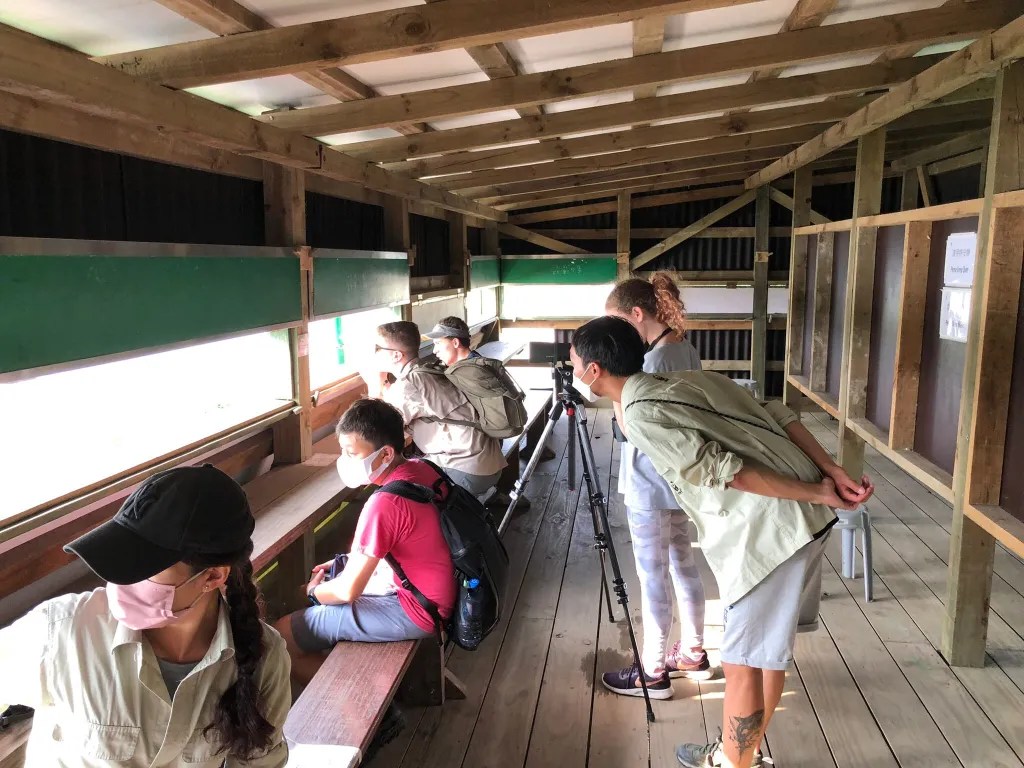
Obviously, I wouldn’t write a post in my wildlife watching blog if my project was just tree tagging. I had to incorporate something related to birding in my plan! I led two short educational tours in addition to the survey to teach scouts about the very access-restricted wetland reserve. Orca and Maggie helped identify some species and helped guide the scouts to different areas of the reserve while I did some teaching. On day one of the tour, we tree tagged for about 1 hour, 20 minutes. At 4:00pm, I began the educational tour, teaching scouts about Mai Po’s history, and interesting plants and animals we saw, including birds, mangroves and reed beds. We visited several areas of the reserve, including a boardwalk through the reed ponds and mangroves and the water buffalo marsh. At 4:30, we arrived at a bird hide where I taught scouts about the birds in view, including some interesting species that Orca helped spot. It was the tail end of the migratory season, so some interesting species were visible including Eurasian Curlews, tons of Pied Avocets and breeding Black-Winged Stilts. On our way there, we saw Collared Crows, Black-Faced Spoonbills and Yellow Bitterns. That about concluded day 1 of the project– some cool birds, a nice tour and an interesting survey.

On day 2 of my project, I started the educational tour at a similar time as the weekend before after tree tagging for 2 hours, but I brought everyone to a different area of the reserve than last time. On the way, Orca spotted a Little Heron, another Hong Kong lifer for me. We explored the Floating Boardwalk through Mai Po’s main mangrove forest, and Mudflat Hides– unfortunately the diversity of birds was nothing compared to a month ago when I came here.
During the tour, I again taught scouts about Mai Po’s history, and interesting plants and animals we saw, including birds, fiddler crabs, mudskippers, and a species of miniature damselfly endemic to Hong Kong. We walked to the closest bird hide, which overlooks Mai Po’s famous mudflats, a place where thousands of migratory birds congregate during the migratory season. However, as the season for migrants ended the week prior, few birds remained today beyond ubiquitous numbers of Little Egrets and Great Egrets. Soon after arriving, we began walking back to the reserve entrance. As we were walking, Orca noted the song of the Indian Cuckoo, a lifer and my 100th wild bird species in Hong Kong (though I don’t usually record birds of my life list solely based on hearing their song).


Overall, this Eagle Project went great and despite the oppressive heat on both days and general lack of birds on the second day, I was extremely happy that my last memory of Hong Kong before leaving the city forever on June 2nd was spent helping a place I love with two organizations I respect a lot: Boy Scouts and the WWF. While the main focus this time wasn’t birding, which is why I don’t go into too much detail in this post regarding what species I saw, I think that being able to see how real biologists work in the field, and being able to care for a globally important ecosystem has given me even more insight that my ambition in life is to be a zoologist and conservationist helping to save threatened species and ecosystems. I also loved teaching people about the wonders and birdlife within Mai Po. I’m going to continue to strive toward my Eagle rank this summer, and at the same time I’ll keep my interests and passions alive in the US. When I get to Singapore, my next steps will be to join the local nature society and to get involved with conservation in Singapore and nearby Malaysia. Thanks for reading, and I’m gonna miss Hong Kong!
Bird Species Recorded: (32 total, including 1 overall lifer and 2 Hong Kong lifers)
Indian Cuckoo (song only) (Lifer)
Little Heron (Hong Kong Lifer)
Yellow Bittern (Hong Kong Lifer)
Cattle Egret
Little Egret
Chinese Pond Heron
Black Kite
Red-Whiskered Bulbul
Crested Myna
Black Drongo
Chinese Bulbul
Eurasian Tree Sparrow
Eurasian Curlew
Black-Faced Spoonbill
Scaly-Breasted Munia
Azure Winged Magpie
Gray Heron
Asian Koel
White Wagtail
Little Grebe
Collared Crow
Black-Winged Stilt
Pied Avocet
Red-Billed Blue Magpie
Red-Billed Starling
Plain Prinia
Oriental Magpie-Robin
Japanese White-Eye
Masked Laughingthrush
Black-Collared Starling
Great Egret
Greater Coucal
 Bennett Gardner Wildlife Watching
Leave a comment