
Singapore is a big city. Not necessarily big in its physical size; virtually the whole city-state lies on a small, mostly flat, diamond-shaped island situated directly below the southern tip of Peninsular Malaysia. But big in its population, culture, and economy. In just one generation since its independence, the nation was, due to the hard work of the government and civilians alike, transformed from a developing former colony into a landmark major city. It has near-flawless infrastructure, world-class architecture, and a plethora of amenities for citizens. It has been and still is an international trading hub and tourist destination. It’s also worth mentioning that the globally important Port of Singapore is recognized as the maritime capital of the world. All in all, its fair to say that this resource-poor, tiny island country has done an exceptional job at becoming a thriving, colorful metropolis.

However, to keep an ever-growing, resource-hungry population satisfied, Singapore has cleared 95% of its forests and natural areas since its establishment in 1819. Because of this extreme loss of natural habitat, 3 out of every 10 animals that once inhabited the country are locally extinct: tigers, sun bears, and elephants are among these species. The remaining 5% of natural areas in Singapore are heavily protected by law, and are for the most part open to public access. It is estimated that 50% of the city’s biodiversity is found only within 0.5% of its land area, including quite a number of endangered species. Since 1992, Singapore has fought to conserve and retain its unique biology into the far future. By creating more nature preserves and doubling down on conservation initiatives, the city is working hard in this regard.

In my opinion, no animal represents Singapore’s fight to preserve its plant and animal life better than the critically endangered Raffles Banded Langur. It is a large species of arboreal, folivorous colobine (a leaf-eating subfamily of monkeys) found only in fragmented patches of rainforest in southern Malaysia and central Singapore. Once common throughout the island, the 70 monkeys still clinging onto life here today solely inhabit a few areas of forest in Singapore’s Central Catchment. Since moving here, it has been a goal of mine to seek out and encounter a group of these beautiful creatures in their natural habitat. And no place is better than Thomson Nature Park, a brand-new wildlife reserve and popular hiking destination opened in 2019, which holds an interesting history. I found a date when I was free to embark on a trip to the park to do some mammal-watching, and I decided to invite my dad along so he could see a new and interesting part of Singapore.

Some history on Thomson Nature Park: from the 1800’s to 1960’s, but especially during the 1930’s, the park was a thriving Hainan (southern Chinese) village, where local people grew fruit and crops to support their families. Today, the structures within the abandoned village are no more than ruins overgrown with native rainforest. The villager’s fruit trees still stand amongst the native vegetation of the park and attract a variety of wild animals, including the langurs. A series of maintained trails bring visitors through this protected land.
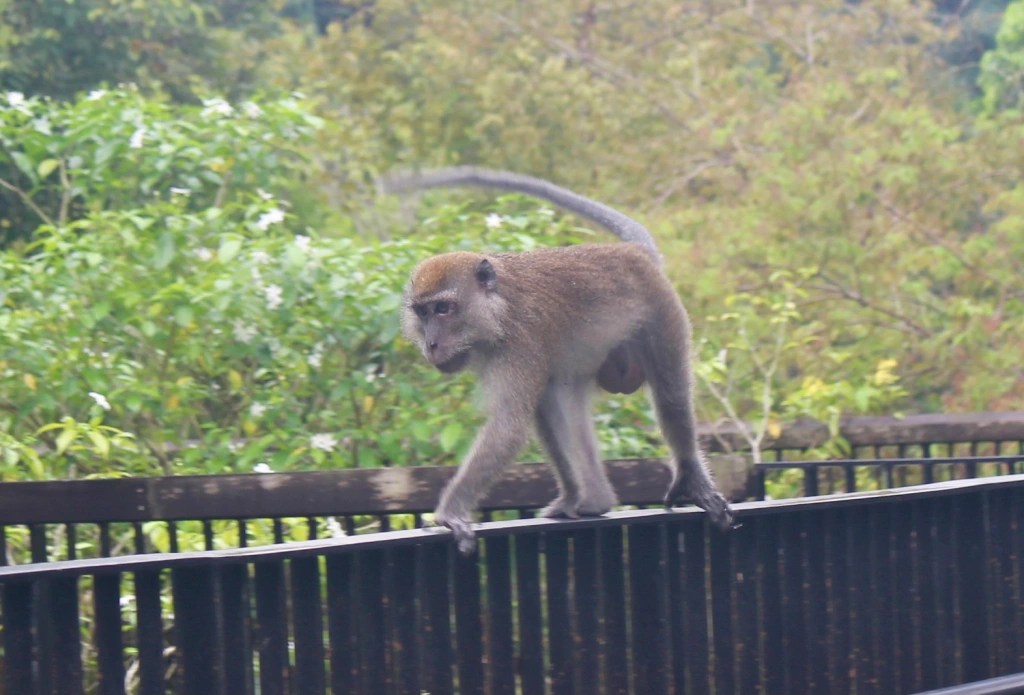
My dad and I arrived at the park around 10am on Sunday the 21st, on the way spotting a Wild Boar walking alongside the highway. It was overcast and humid, and I mistakenly wore my long-sleeved safari shirt, which kept me hot and sweaty throughout the whole endeavour. Before entering the park, we saw Plantain Squirrels, starlings, and a lone Common Iora near the parking lot, and a large male Long-Tailed Macaque at the trailhead.

The overpowering feel of entering the rainforest can only be described as “surreal”. There is so much diversity and life here it is impossible to take it all in at once. We strolled along one of the reserve’s major trails, peering into the canopy, attempting to spot langurs and rainforest birds. There were quite a few structural ruins and fruit trees amongst the greenery. As for animals, raucous birdsong made it hard to pinpoint any avian residents, but there were macaques galore, as well as a lone Slender Squirrel which scurried hurriedly up a branch. Rounding a bend in the trail, we found a really neat-looking Greater Racket-Tailed Drongo, a bird which truly lives up to it’s name. I mean look at that awesome tail! (It was also my second bird lifer of the day.)


We continued walking, keeping our fingers crossed for a sighting of the elusive langurs. After rounding a large clearing in the forest, we took an earthen track toward a trail leading toward Old Upper Thomson Road, a paved road separating Thomson Nature Park from the larger Central Catchment Nature Reserve. Macaques and langurs use rope bridges attached between the trees on either side of the road to visit both patches of rainforest. It is apparently a hotspot for langur sightings, so we started making our way over there.
At 10:50 am, however, we had a totally unexpected and tremendously lucky run in with two amazing Dusky Langurs on the trail to the road!! Though not the exact species we were searching for, the monkeys we saw were of a locally rarer species, first noted in 2019 after being driven to extinction in Singapore. They are found in pockets of forest in Peninsular Malaysia and southern Thailand and are thought to have migrated from Malaysia to Singapore quite recently, possibly by swimming. There are 3 individual Dusky Langurs in the entirety of the country, and we were lucky enough to spot 2 of them!
When we first saw the Dusky Langurs, they were resting on a tree branch about 8 meters (25 feet) off the ground and probably 12-15 meters (40-50 feet) away from the trail. They stayed for probably 10 minutes from the time we arrived and were quite relaxed and confident despite a number of human observers; one of the langurs dozed while the other used a notch in the branch as a seat to rest its head. My dad and I took turns with my binoculars to get a clear view of the monkeys. Eventually they departed into the canopy nearby, climbing to probably 25 meters (80 feet) high in some dense foliage which is where we last saw them. What an amazing encounter! I later asked my AT Environmental Science teacher who is also an avid birder/wildlife watcher about the langurs in Thomson Nature Park. He said after 70 walks in the reserve, he’d seen them only 7 times, and that I was really lucky to spot them at the time of day I did. He also gave me the email of a local primatologist (researcher of primates), and asked me to send details of my encounter to her (which I very enthusiastically did). As it turns out, after mistakenly misidentifying the langurs we saw as Raffles Banded Langurs, I was told by the primatologist who saw my photos that they were actually Dusky Langurs.


After the long and lucky encounter with the monkeys, my dad and I continued on to Old Upper Thomson Road, which was crowded with pedestrians, cars and cyclists alike. Rubber Trees brought from South America in the 1800’s and propagated in Singapore to be transported around Southeast Asia are still found along this road, some trees dating to the 1850’s. Additionally, Oil Palms planted by Hainan villagers are found here, providing food and a resting stop for macaques and birds. The Oil Palm is a plant that is currently the cause for much of the deforestation in Malaysia and Indonesia. It’s nice that here at least, the palms are used by wildlife and not just humans.


Around 11:30, we were back on the trail toward the reserve entrance, spotting some loud Long-Tailed Parakeets flying overhead. We arrived back at the parking lot at 12 noon and took a cab home shortly after, super happy with our short morning expedition to the reserve. Based on my last two expeditions into its greener areas, I’m really surprised with the amount of wildlife in Singapore (especially the fact that endangered species like the langurs still thrive here). Then again I can’t be too surprised, given Singapore’s location in Sundaland. Sundaland is a biogeographical region incorporating Borneo, Java, Sumatra, Peninsular Malaysia and Singapore, and supporting some of the oldest and most diverse rainforests in the world. It is a place I want to work in someday (especially Borneo), and getting to know Singapore’s wild side is a perfect introduction into making this my career area someday. Thanks so much for reading as always, and I look forward to doing some more birding and wildlife watching in the near-future! (Hopefully finding the Raffles Banded Langurs themselves)
Mammal Species Recorded: (5 total, including 2 lifers)
Dusky Langur (Lifer)
Slender Squirrel (Lifer)
Long-Tailed Macaque
Plantain Squirrel
Wild Boar
Bird Species Recorded: (6 total, including 2 lifers)
Greater Racket-Tailed Drongo (Lifer)
Common Iora (Lifer)
Long-Tailed Parakeet
Javan Myna
Zebra Dove
Asian Glossy Starling
 Bennett Gardner Wildlife Watching
Leave a comment