
It’s been a while since I’ve written a blog post! Between sports 4 days a week, an ever-growing amount of homework for my classes (including 2 AP’s), my social life, and other obligations, I’ve found it hard to get out to natural places in search of birds and other wildlife. Additionally, I’ve been working hard to improve my physical health, and have lost quite a bit of weight since this summer. I really want to get out more though, especially since my girlfriend is also interested in birds and nature. It’s nice having someone to accompany me on my outings to far-off places in search of cool critters. We’d planned to go birding on Singapore’s last rural island, Pulau Ubin, a few weeks ago, but our plans had been cancelled twice in a row because of inclement weather.
Last Saturday, the 1st of October, we both found a day suitable for us to visit Pulau Ubin. I got up at 6:30 to make it to the ferry terminal in Changi Village, where we’d catch a sampan (called bumboats here) to the island. We got moving this early to make the most of the day before our afternoon commitments. Changi Village is about an hour and a half via public transportation from my house. It was a long haul for both of us. I arrived an hour earlier than she did, giving me time to work out the ferry situation.
Already, the heat and sunlight were oppressive and I was sweating as I attempted to locate the entrance to the ferry terminal. Changi Village is actually quite a nice area, edged by a canal full of fishing boats and bumboats and a small recreational peninsula connected to the village via a bridge. I heard what sounded like cockatoos in some Ficus trees, and peering through my binoculars I caught sight of a flock of Tanimbar Corellas taking to the wing (my first lifer of the day). These fully white, Indonesian endemics are non-native to Singapore and have established themselves in many lightly wooded areas throughout the country.
On my way to pick up my girlfriend at the bus stop, I saw a really interesting reptile known as a Sumatran Flying Dragon, climbing up a tree trunk. These little guys are the only lizards capable of gliding (with a pair of expandable ribs or “wings”.) They can make 200-foot flights between trees without losing more than 30 feet of altitude, a seriously impressive feat for such a small animal!

We met up and walked to the ferry terminal shortly after; then waited in line for the boat to leave. Interestingly, the bumboats carrying passengers to Pulau Ubin depart only when enough people are in line. Luckily, it was a Saturday, so plenty of passengers from the mainland like us two wanted a lift over to the island. Aboard, we paid 6$ each and sat back and relaxed for the 15-minute ride over. While it was rather hot and sunny at Changi Village, the weather began to improve as we roared along in the bumboat: it became a mixture of clouds and sun with ample breezes flowing down the coast. Along the way, we saw some wading birds, including a lone Milky Stork perched on a piling as we exited the canal and advanced into open water.
Singapore is composed of one main island, on which the city is built, and a collection of smaller, “satellite” islands like Pulau Ubin; most of them flat and developed. Pulau Ubin has the distinction of being Singapore’s last truly rural area; a 4-mile long, boomerang-shaped piece of land carpeted in forest, fruit orchards and mangroves. On the eastern end lies the Chek Jawa wetland, complete with mudflats and mangroves, and known for its birdlife and unique biodiversity.
The majority of the island is forested; most of it secondary rainforest; some of it fruit and other cash crops grown within the native vegetation by villagers. There are also several lakes scattered throughout Pulau Ubin that were once quarries for granite but have since been closed down and flooded. A system of paved paths bring hikers and cyclists to the main sites of interest.
The starting point for all travellers to the island is located in Singapore’s last “Kampong”, or rural village, Ubin Town. This is where the ferry drops off and picks up and it’s where visitors can rent bikes, eat at local restaurants, or begin hiking.

Because of its importance as a green area and for its biodiversity, the Singapore government has set out to preserve the island in its current state for as long as possible. Over 240 bird species, including many species not found anywhere else in the country, an impressive 700 native plant species (including several heritage trees and endangered plants) and 30 mammal species make their home here. During winter and migratory seasons, a variety of interesting birds are found, including White-Rumped Shamas, Mangrove Pittas, Oriental Dollarbirds and Blue-Tailed Bee Eaters. As it was the first day of October, it was the beginning of the migratory bird season and our hopes were high as we set off. On the top of our list for bird sightings was an Oriental Pied Hornbill, a spectacular creature that made a surprising comeback in Singapore over the past 3 decades. Hornbills are also my girlfriend’s favorite bird, so I was extra keen on finding one.
After arriving in the Kampong around 10:45am, we took a trail into the island’s lush interior. Close to the village, I snapped a photo of some Zebra Doves on the trail, a common but nonetheless pretty species. As we passed a freshwater pond edged by Coconut Palms and verdant jungle, we spotted a lone Purple Heron plucking fish from the water’s edge, a first for me in Singapore. Swooping through the air were a collection of swifts and swallows, most of which I couldn’t pick out except some Pacific Swallows, my second lifer of the day.


A plethora of cyclists and pedestrians passed us as we turned onto one of the main trails on the island which leads to Chek Jawa wetlands. We thought it would give us a good opportunity for some interesting bird sightings. As we plodded on deeper into Pulau Ubin’s rain forested interior, the island’s sizeable population of Long-Tailed Macaques began showing itself along the trail. We walked through quite a few ecosystems on our way to the wetlands, including brackish swamp, fruit orchard and secondary rainforest. It’s really nice having an area of Singapore to get away from the hustle and bustle of the city altogether! There was one spot where an enormous Common Pulai, a thick-trunked tree, grew. Additionally, as we neared Chek Jawa, we had an encounter with one of Pulau Ubin’s resident Wild Boar.

We arrived at the wetlands around noon, the weather becoming increasingly overcast. After exploring the local museum, located on the inside of an old British vacation home, we set off on the nearby boardwalk to explore the area farther. During low tide, mudflats are exposed where birds and other organisms gather to feed. Unfortunately it was high tide and the only area with birds was a smaller, rocky islet farther from the coast known as Pulau Sekudu. This tiny island has a cool origin story.
As legend has it, a pig, an elephant, and a frog challenged each other to a race across the straits of Johor from Singapore to Malaysia, with the losers being turned into rock. All three failed; the pig and elephant merged together to become Pulau Ubin and the frog became Pulau Sekudu. We saw some Whimbrels and a Gray Heron preening themselves on boulders there. We took turns peering through my binoculars to get a good view of these waders.

Afterwards, we took the boardwalk around the eastern tip of the island and followed it into a large grove of Rhizophora mangroves (your classic “stilt-rooted” mangroves), as well as some Nipah Palms (the only palm species capable of surviving in brackish water). We climbed up a very high observation tower which provided scenic, 360-degree views of the entire Chek Jawa wetlands as well as the Straits of Johor and mainland Singapore.


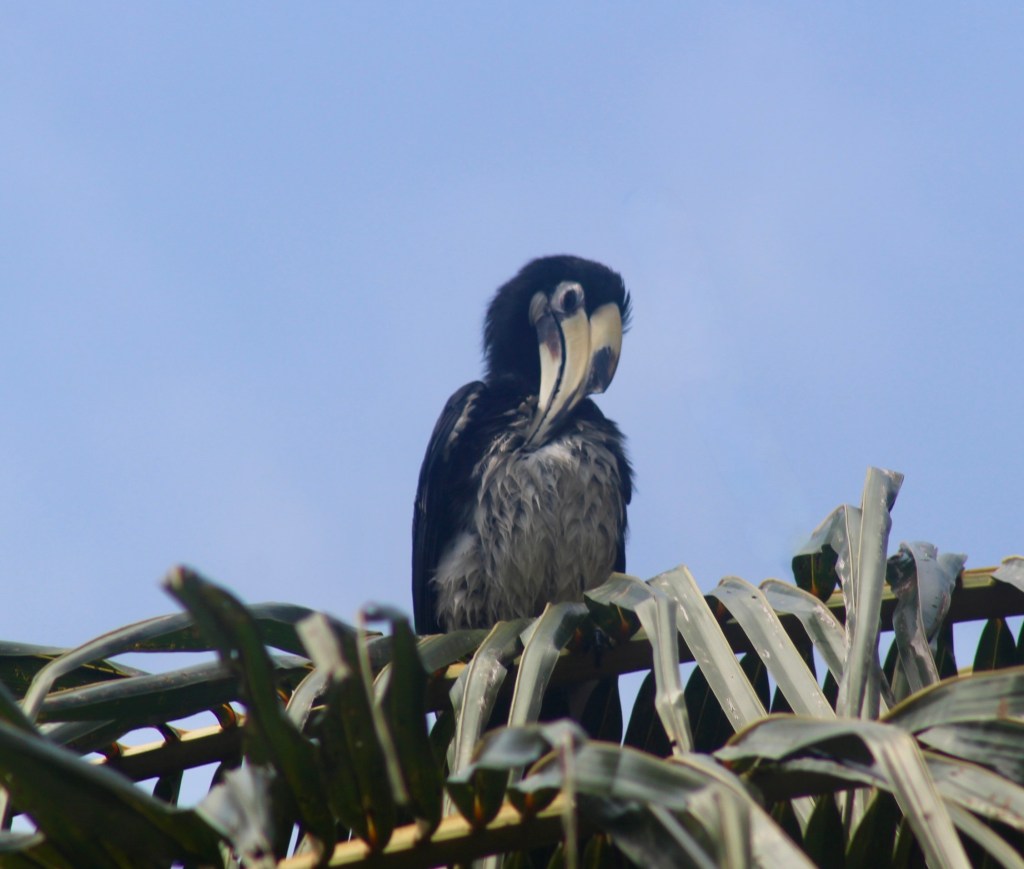
We scanned the carpet of trees below for any interesting birds. After seeing nothing for a few minutes, I suddenly spotted two large, black birds perched in some fruiting trees a couple of hundred yards away. “Hornbills!”, I shouted, and my girlfriend was right there next to me, both of us jumping in excitement. These Oriental Pied Hornbills (a lifer for me) are 2 of around 50 that inhabit Pulau Ubin and represent the species main stronghold in Singapore, a place where they were once pushed to extinction in over a century ago. They have beautiful casques and elongated, thick bills for plucking and eating fruit and smaller animals. Throughout the island, the government has installed nesting boxes to encourage breeding, and this conservation program has worked remarkably well in bringing back the hornbill to Singapore.

Afterwards, both of us very satisfied to find our target species, we began walking back to the village around 1pm. The weather was closing in fast, and both of us had commitments later in the day so we sped walked/ran most of the way back! The rain did catch up to us at the end, so we had to share my girlfriend’s little umbrella to protect against the downpour, both of us ending up completely soaked at the end. In the village, we grabbed a quick (expensive) lunch and took the ferry back toward Changi Village. Luckily, the rain cleared soon after we ate and by the time we were back at the terminal, it was partly sunny and milder. Before splitting off, we took a walk together across the bridge leading over the canal to the green public peninsula on the other side. Here we actually saw some cool species! First was a Collared Kingfisher perched on a sprawling Banyan tree, then an Oriental Magpie-Robin, a species common in Hong Kong but rarer in Singapore because of capture for the illegal pet trade. Its beautiful song is prized by avian collectors.
Then came the biggest surprise of all: a tree full of hornbills! There were probably 4 or 5 female and male Oriental Pied Hornbills in this one Coconut Palm, preening their wet, rain-drenched feathers! It was super cool to see these amazing birds in even closer proximity than before, and they provided some nice photo-ops.


My cab arrived shortly after and I had to depart. The outing altogether was great! I can’t wait to get out more with my girlfriend birding and wildlife watching in the near future, so stay tuned as always for more posts! I have some cool areas in mind of where we’ll go next to seek out some more pretty birds. Thanks for reading,
-Bennett
Bird Species Recorded: (17 total, including 3 lifers and 3 Singapore lifers)
Oriental Pied Hornbill (Lifer)
Pacific Swallow (Lifer)
Purple Heron (Singapore Lifer)
Whimbrel (Singapore Lifer)
Oriental Magpie-Robin (Singapore Lifer)
Eurasian Tree Sparrow
Zebra Dove
Milky Stork
Spotted Dove
Javan Myna
House Crow
Gray Heron
Collared Kingfisher
Asian Koel
Rock Pigeon
Asian Glossy Starling
Black-Naped Oriole
Mammal Species Recorded: (2 total)
Long-Tailed Macaque
Wild Boar
 Bennett Gardner Wildlife Watching
Leave a comment