
Who would’ve thought that the world’s first tropical botanical garden inscribed as an UNESCO World Heritage Site, would be an absolute hotspot for birding? I for one did! Located roughly around the most built-up area of the city, Singapore’s botanical gardens, established here in 1859, played a key role in the early history of the city. It was here during the late 1800’s that seeds of the South American Rubber Tree were first nurtured into young plants, and the saplings then transported around Southeast Asia to be grown in newly-established plantations. The rubber trade boomed in the region in the early 20th Century, generating quite a bit of wealth for Singapore and the countries surrounding it (Indonesia and Malaysia).
Many other crops and ornamental plants have been studied, grown and experimented on here in years past. Currently, the gardens are mainly known for their recreational, educational and scenic values. In their 82 hectares (200 acres), the gardens house some 10,000 species of plants, in addition to a 15-acre tropical rainforest!

Yeah, quite an awesome place for nature nerds like myself. But plants weren’t the main reason why my interest was piqued in returning to the gardens (I visited them briefly with my family a few days after moving here). The Singapore Botanic Gardens house over 200 species of birds, and, as the migratory season is now in full swing (October, 2022), many Palearctic specialties are making their way down from Russia and Manchuria to winter in Singapore and other areas of Southeast Asia. Coupled with the fact that the entry to the gardens is free, the paths are well-maintained and the gardens themselves are easily accessible from most areas of the city, I really wanted an opportunity to bird this special area of the city-state!
Lucky for me, my then-girlfriend, who’s always up for a birding outing, thought the gardens were a no-brainer. We picked a date that worked for both of us: the first Saturday of our school’s fall break, October 15th. Over the course of about 4 hours, we trekked almost 3 miles and catalogued 15 species of birds and 3 species of mammals.

After meeting up around 10am at the garden’s Tanglin Gate, we began our jaunt into the greenery. Almost right off the bat we spotted our first of many Red Junglefowl rooting through the undergrowth. There are many mixed flocks of junglefowl in Singapore: these handsome ancestors of chickens are prone to hybridizing with domestic fowl, disrupting the purity of wild bloodlines. Only a sprinkling of truly wild Red Junglefowl inhabit the gardens; we were lucky enough to spot some later on. Wild junglefowl are given away by their slate-gray legs (as opposed to the yellow legs on chickens). As we left the area adjacent to Tanglin Gate, we noted some Cichlid fish in a pond and a reddish damselfly perched on a cattail.

As we walked, we familiarised ourselves with the multitudes of unique flora grown just about everywhere. Many of the trees and shrubs we saw were labeled, helping us improve our knowledge of botany as we strolled through different areas of the gardens. Omnipresent Javan Mynas, Pacific Swallows and Rock Pigeons constituted the majority of birds we saw as we walked from Tanglin Gate to an area of the gardens known as Swan Lake. While there were a few Mute Swans gliding through this weedy water body, these captive birds are not counted by birders as a species observed due to their reliance on humans for subsistence.
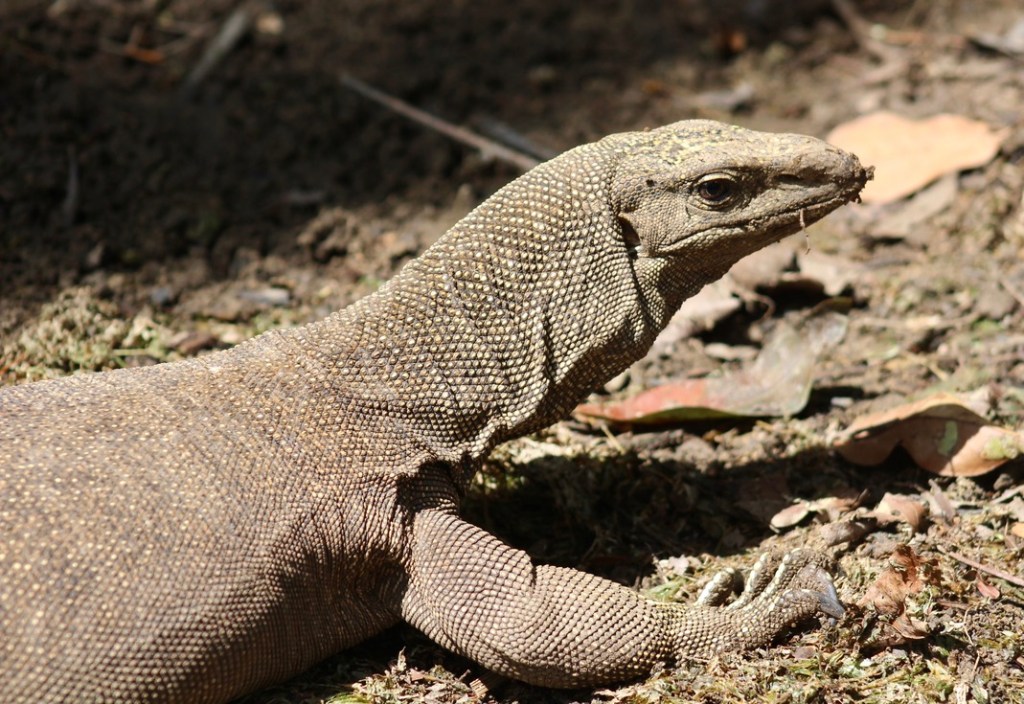
As we circumvented the lake, we saw tons of Malayan Water Monitors (Varanus salvator) digging for insects and other prey in some decaying plant clippings. These large lizards are really interesting to watch as they go about their business. It’s unique to have sizeable, wild reptiles in the center of a large city.

Mixed in among the mass of monitors was a lone White-Breasted Waterhen, a common but pretty member of the rail family. I saw tons of this species in Hong Kong, specifically in Mai Po, and it’s also quite widespread in Singapore. My girlfriend and I enjoyed watching the little rail peck around for invertebrates before scurrying off into a thicket.

We continued on to the Ginger Garden, an area of the gardens where hundreds of species in the ginger family are grown. Interestingly, we learned that both Bananas and Plantains are gingers (Zingiberales) along with a whole host of unsuspecting plants! (In fact, there are over 1,600 species of gingers total). Here we spotted a Yellow-Vented Bulbul in a nearby tree along with a female Red Junglefowl and her chick.

After some more walking, we arrived at a pleasant spot known as Symphony Lake, adorned with palms and tropical shrubbery. It was around 12 noon at the time. There were quite a few pond turtles in the lake, mostly Red-Eared Sliders. We sat on a bench in the shade overlooking the lake for a few minutes to rest. Meanwhile, a handsome male Red Junglefowl walked right up to us from the nearby woods, within a yard or two! This habituated individual was presumably of fully wild-blood and provided a nice photo op to us as it pecked around. While Red Junglefowl are absolutely everywhere in the botanic gardens, encounters this close aren’t that common. How cool!

A little farther along the lakeshore, we ran into a Spotted Dove hopping along the path. This bird was also very habituated, probably owing to illegal food handouts from visitors. Spotted Doves are a very widespread species in South and Southeast Asia; they’ve been an abundant species in every Asian city I’ve lived in.

We moved on to the eastern portion of the gardens, seeing some Olive-Winged Bulbuls and other common species on our way there. We turned around upon reaching one of the garden’s many gates. The main path was becoming increasingly crowded, so we turned onto an uphill side path leading to the Evolution Garden.
This was an interesting area; ancient varieties of plants or “living fossils” are grown here. Such species as Araucaria, a group of conifers dating from the Mesozoic and once widespread, but now reduced to a few islands in Oceania and pockets of South America, make their home here. We enjoyed learning about these unique prehistoric plants, many still clinging onto life in remote pockets of the world.
As for additional birds, we had a pleasant run-in with a bright yellow female Olive-Backed Sunbird in a conifer. We also came upon an Asian Brown Flycatcher, a Palearctic migrant, as we were leaving this area of the gardens: a Singapore lifer for me.

Afterwards, we took a detour into the garden’s own tropical rainforest. The birdlife here was great and exceeded our expectations! We took a boardwalk from the main path into the dense foliage of the jungle, racing ahead of several large groups of people and keeping our eyes peeled for unique birds. Apart from the ubiquitous junglefowl pecking through the undergrowth, we managed to spot two Greater Racket-Tailed Drongos that alighted on a branch quite close to us! These individuals had the strikingly elongated tail plumes particular to this species.

We returned to the main path and strolled along the perimeter of the rainforest, finding a more secluded path into the undergrowth, leading out from a resting pavilion. From the pavilion, there was an area where one could peer into the depths of the forest and observe the wildlife inside. Here we had our best birding score of the day: 4 species and 2 lifers within the span of a few minutes!
First up were some more drongos, followed by an elusive treat: a female Amur Paradise Flycatcher! This beautiful species was a lifer for both of us, and while very skittish, we did our best to locate it as it moved between branches in the canopy of the rainforest. With a cream belly, a chestnut back and a black head and crest, this unmistakeable Palearctic migrant is a joy to see!


The flycatcher moved off, but our luck hadn’t run out yet. A Slender Squirrel, a species found only in 3 locations in Singapore including the botanic garden’s rainforest, made a brief appearance. In addition, we spotted a colorful male Pink-Necked Green Pigeon feeding on some berries at the top of a palm tree.
While we were observing the pigeon, a raucous chattering erupting from a nearby tree. There were about 6 small songbirds chirping, and after some additional observation we concluded that they were Pin-Striped Tit-Babblers, another lifer for both of us!

Very satisfied with our luck, it was around 1pm and we were ready to begin exiting the gardens. First, we took a relatively quick detour to the Keppel Discovery Wetlands to see an additional area of the gardens and to possibly nab a few more species. On the way, I spotted a Common Treeshrew, a lifer, and an interesting type of mammal. Once classified as an insectivore, then a primate, it is now placed in its own order of mammals. It is believed to be a close cousin to primates. Despite its name, Common Treeshrews forage for food on the ground. After the treeshrew scurried off, we enjoyed a view of the wetlands at an overlook for a few minutes before striking off to circle around where the trail ended.


As we reached the end of the trail, we heard birdsong in some nearby trees. Peering through my binoculars, I was surprised to spot yet another lifer for both of us: a Common Hill Myna! These glossy, black birds possess a distinctive yellow marking behind their eyes which differentiates them from other myna species. My girlfriend located another hill myna in a different tree, and we watched them sing back and forth for a few minutes before making our way out of the garden at around 1:45pm.


Overall, I’d say this was a pretty awesome birding outing! The Singapore Botanic Gardens shows just how much biodiversity (and in this case, bird diversity) is capable of thriving in urban areas given adequate green space. I will almost certainly be back here soon for some more inner-city birding and to explore some additional areas of the gardens. Thanks for reading as always,
-Bennett
Bird Species Recorded: (15 total, including 3 lifers and 1 Singapore lifer)
Amur Paradise Flycatcher (Lifer)
Common Hill Myna (Lifer)
Pin-Striped Tit-Babbler (Lifer)
Asian Brown Flycatcher (Singapore Lifer)
Spotted Dove
Rock Pigeon
Pink-Necked Green Pigeon
White-Breasted Waterhen
Red Junglefowl
Olive-Winged Bulbul
Yellow-Vented Bulbul
Pacific Swallow
Greater Racket-Tailed Drongo
Javan Myna
Olive-Backed Sunbird
Mammal Species Recorded: (3 total)
Plantain Squirrel
Common Treeshrew
Slender Squirrel
 Bennett Gardner Wildlife Watching
Leave a comment