
It’s been a busy semester for me. Busy to the point where, in the past month or so, I hadn’t gone out birding or nature-exploring much. Unusual for me.
More on my mind in recent weeks toward the end of the term have been grades, friends, college, and did I say grades? But nevertheless, the 14th of December marked my last day of school in 2022 and what a year it was! Besides exceeding my goals in academic success, which has historically been a rather difficult thing for me due to my ADHD, I am proud of my growth in many other ways this past year. For starters, I began birding, wildlife photography and blogging this year, and look how far I’ve come! Moving to Singapore led to an array of good things for me. I began lifting weights consistently, as well as cutting back my caloric intake to lose weight. I’ve been overweight most my life and felt like making a change. In the past 4 months, I’ve lost 30 pounds due to my healthier lifestyle; a feat I’m extremely proud of myself for accomplishing. In Scouts, after 5 years of hard work, I earned the prestigious Eagle Scout rank in September which has been another great source of pride for me. And, of course, meeting my girlfriend was the icing on the cake of my accomplishments this year. To think how much I’ve grown in 2022 is crazy, and I look forward to another great year in 2023!
Now that you’ve gotten a brief update on my life, let’s move onto the blog post.
Singapore is one of Earth’s most biodiverse cities: it blows most other major metropolises out of the water in terms of native plant and animal species. This includes my old home, Hong Kong, which itself is quite biodiverse. Why is that though? Singapore is a small country at a mere 283 square miles (a little more than half the size of New York City), and with a population of 5 million spread out over this small area, it is therefore extremely densely populated.
You’d think that any substantial biodiversity would’ve been wiped off the map long ago. But Singapore’s nature-friendly design and conservation-heavy mindset has prevented human activity from taking over certain areas of the country where an extreme wealth of species, some of them brand new to science, exists. I’ve had the privilege to visit and explore some of these areas and I’ve been impressed so far!
Bukit Timah Nature Reserve, a 400-acre swathe of virgin rainforest carpeting Singapore’s highest peak—a 500-foot high granite hill of the same name—is perhaps the most important of all conservation lands in Singapore.
In the late 1800’s, when the British ruled the city state, they designated areas of the nation’s then-lush interior as forest reserves. All of these reserves were worked for timber with the notable exception of Bukit Timah. Then, in the mid to late 20th century, most of the reserves received full national protection and the forests have since rebounded, though not to their original state.
While part of Bukit Timah was carved out to quarry granite for construction material, the vast majority of the reserve still consists of virgin rainforest, the last of its kind in Singapore and a primary reason why there is still so much biodiversity in the country today.
In fact, Bukit Timah contains an incredible 40% of Singapores biodiversity in a mere 0.2% of its total land area! I’d been looking for a chance to visit Bukit Timah for some birding and plant-hunting (basically searching for interesting wild plants) for quite a while, and once school ended, I planned for a day that worked for me: the 16th of December.
I started at the visitor center at around 10:30 and made my way into the dense foliage.


I took a dirt track leading toward the summit off the main, paved road that snakes through the reserve, my eyes and ears poised for birds in the rainforest. The ring of cicadas was quite overpowering, and because it was a weekend it was a bit crowded. As I walked up the trail toward the dome-shaped peak of Bukit Timah, I took in the sights of the forest, especially the immense Dipterocarps and other ancient trees. Dipterocarps are a family of 695 economically important rainforest tree species found throughout the tropics, with the highest diversity occurring in Southeast Asia, where they dominate other tree species in the rainforest. The largest species, Shorea faguetiana, can grow to over 300 feet tall! Bukit Timah’s 18 species of dipterocarps might max out at 100-200 feet tall: a bit shorter than their gigantic relatives, but are still noticeably large and ancient due to the lack of human impact in the forest. A window back into the Singapore that once existed centuries ago.


Bukit Timah has astounding tree diversity, possessing 400 native species. This rivals the diversity of trees in North America. Other massive trees dot the rainforest, some of them attaining heritage status due to their great age. This Kayu Pontianak tree (Parishia Insignis) located near the trailhead, through mostly dead, impressed me thoroughly with its sheer size:


Over 1,000 native flowering plants inhabit Bukit Timah, and many along the paths are well-labelled to allow visitors to learn about the botanical delights of the reserve. Some highlights of plants other than trees that I observed included:


The bird activity was generally slow throughout my expedition, in no small part due to the density of the foliage and the tendency of birds in the forest to stick to the treetops. I saw a female Olive-Backed Sunbird near the entrance, along with a glimpse of a White-Bellied Sea Eagle in a forest clearing. The only birds in abundance were Pacific Swifts, which swooped around, hunting insects above the trees. In the forest’s depths I did see a few interesting birds. A Greater Racket-Tailed Drongo, with its distinctive tail plumes, made a very brief appearance in the spot where the dirt track led back onto the paved road (too fast for me to snap a photo). My main burst of bird activity occurred along the road, close to the summit, where in the span of a few minutes I observed two Common Hill Mynas, a cool-looking bird with a beautiful song, followed by a Crow-Billed Drongo, a lifer for myself. It looks very similar to the Greater Racket-Tailed Drongo, yet lacks the plumes of the former and has a thicker, more powerful beak.


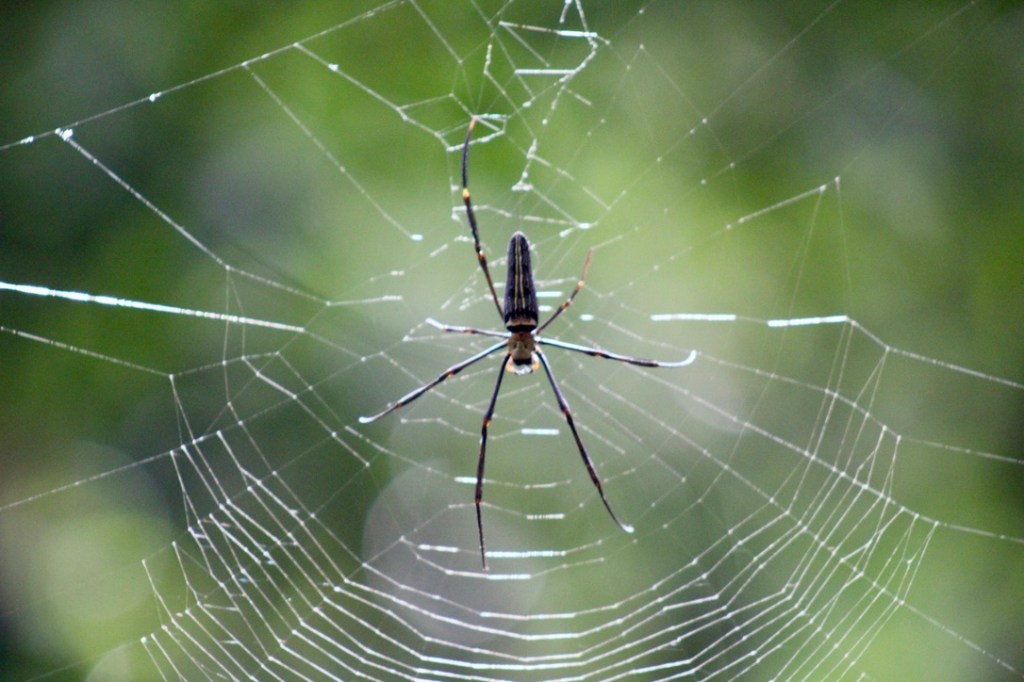
Besides birds and plants, the rainforest of Bukit Timah provided some additional species of interest. Other than monkeys and squirrels, there weren’t any noteworthy mammals. Reptiles and invertebrates proved more interesting. At one point, I noticed a cute little Kendall’s Rock Gecko (Cnemaspis kendallii), a small lizard with striking patterns on its body, on the trunk of a tree. I also spotted a largish Golden Orb-Weaver spider (Nephila pilipes) who had constructed its web between two trees on either side of the road, and saw a Giant Forest Ant (Dinomyrmex gigas) crossing the road. With so much biodiversity, its actually surprising how little you see of the rainforest’s wildlife as much of it remains concealed throughout the day!


I arrived at the summit a little after noon. I stretched my legs, took a bit of a break and headed back down into the forest. After another half-hour, I arrived back at the visitor center and made my way back home to Woodlands.

Altogether, a great outing to end a great year! A virgin rainforest smack-dab in the middle of one of the most developed and densely populated places on Earth really says something about the conservation effort put forth by the Singaporean government and hopefully will serve as a model to nearby countries like Malaysia and Indonesia that continue to destroy their virgin forest to make way for a never-ending sea of Palm Oil plantations.
Primeval wooded areas store more carbon than any other type of forest, and retain the highest levels of biodiversity of any habitat on land. They also protect our water supply, keeping it clean and preventing erosion, and cycle chemicals and nutrients essential for all life.
It is crucial for the longevity of our species that areas like Bukit Timah continue to receive protection and that virgin forests across the world are granted higher levels of protection from extractive human industries.
Altogether, this was a relaxing and highly informative look at one of Singapore’s most amazing wild areas and of the plant and bird species that lay within. I am travelling back to north Florida tonight (the 18th of December) for Christmas break with my family to visit relatives, and I look forward to doing some birding in the cooler temperatures there. Stay tuned and thanks for reading!
-Bennett
Bird Species Recorded: (8 total, including 1 lifer)
Crow-Billed Drongo (Lifer)
Greater Racket-Tailed Drongo
Common Hill Myna
White-Bellied Sea Eagle
Olive-Backed Sunbird
Javan Myna
Zebra Dove
Yellow-Vented Bulbul
Pacific Swift
Mammal Species Recorded: (3 total)
Plantain Squirrel
Slender Squirrel
Long-Tailed Macaque
 Bennett Gardner Wildlife Watching
Leave a comment