
Before I get into this interesting and productive birding outing, I just wanted to say thanks for taking the time to read my blog! This my first post of 2023. It’s been almost a year since I started this blog, with the intention of cataloging my wildlife watching (primarily birding) outings, and other eco-adventures across scattered, biodiverse locations in Hong Kong, my former home, and Singapore, my current home, in addition to other countries my family visits. With the start of a new year upon me, my goal this annum is to expand the reach of my blog to new heights, and gain a broader audience. I also want to continue improving my nature and wildlife photography with the help of my brand new camera (thanks mom!) I’ll no longer have to rely on my decade-old, battered Canon EOS Rebel T5 to capture photos of beautiful wildlife, plants and natural landscapes I seek out and come across. I look forward to sharing more professional-grade photographs from my “bird-stalking” (and other wildlife-focused) trips on this blog in the near-future!
As I write this post about a birding trip I embarked on on the 24th of December, 2022, two weeks ago, I’m sitting in my living room, feeling the full effects of jetlag on my body. I’m in Singapore after 3 weeks of visiting relatives in North Florida. It was, as one might imagine, hard to find time to embark on an outing while in Florida due to family obligations, but I managed to squeeze one in on the coldest Christmas Eve Florida has experienced in 30 years. A blast of Arctic air from Siberia made its way southeast, ramming through the North American continent on the week prior to Christmas. The waft of frigid air hit North Florida on the night of the 23rd. The temperature in St. Augustine, where my grandparents live, dropped like a stone on that night. In the span of 10 hours, the mercury plummeted from the low 50’s (Fahrenheit) to a nippy 26 degrees!

This rare hard freeze spelled disaster for the many ornamental tropical plants (and their disheartened owners) growing in my grandparent’s neighborhood: Rose Hibiscus, bananas and Bougainvillea just to name a few. As for the native animal taxa of the region, all accustomed to subtropical winter conditions, the cold weather and bitter breezes made them lethargic and sluggish. I, myself, used to year-round heat and humidity, welcomed the change in temperature but nevertheless bundled up in 3 layers (and my grandfather’s army jacket, which he generously lent to me for the day), to handle the icy air for the duration of my birding outing.

After arising early to experience the cold the morning of the 24th, I found that the once-in-a-generation frigid spell had a very beautiful side. The dryness of the Siberian air transformed the normally humid, cloudy atmosphere of Florida into bright, cloudless sunshine. Most people in the neighborhood had left their sprinklers running all night to avoid pipe damage from the freeze, which had formed icicles in certain areas. Most notably on this Eastern Red Cedar, which was adorned with beautiful icy ornaments for several hours that morning:


I set off on my outing at 11:30 am, to a famous, coastal preserve on the outskirts of St. Augustine called Anastasia State Park, popular with local birders and an area I’d never visited before. For those history buffs out there, St. Augustine and areas around it like Anastasia contain many sites of interest like Castillo de San Marcos, the oldest surviving masonry fort in America. The sedimentary Coquina stones used to build the fort in the 17th century were quarried in what is now Anastasia State Park. These historic quarries can still be visited to this day— I didn’t get a chance to on my visit.
Despite its relatively small size, Anastasia State Park encompasses a surprising variety of habitats and a plethora of bird species—over 200 have been recorded in recent years. During the winter migratory season, Florida’s coastal areas are choc-full of waders and waterfowl wintering in the state. Because of this (and the much cooler temperatures), winter is the best time to go birding here. The main road which runs through the southern part of the park contains most sites of interest, especially to birders. Trails that break off from the road take one through many different habitat types, from salt marsh to coastal dunes to maritime hammock.


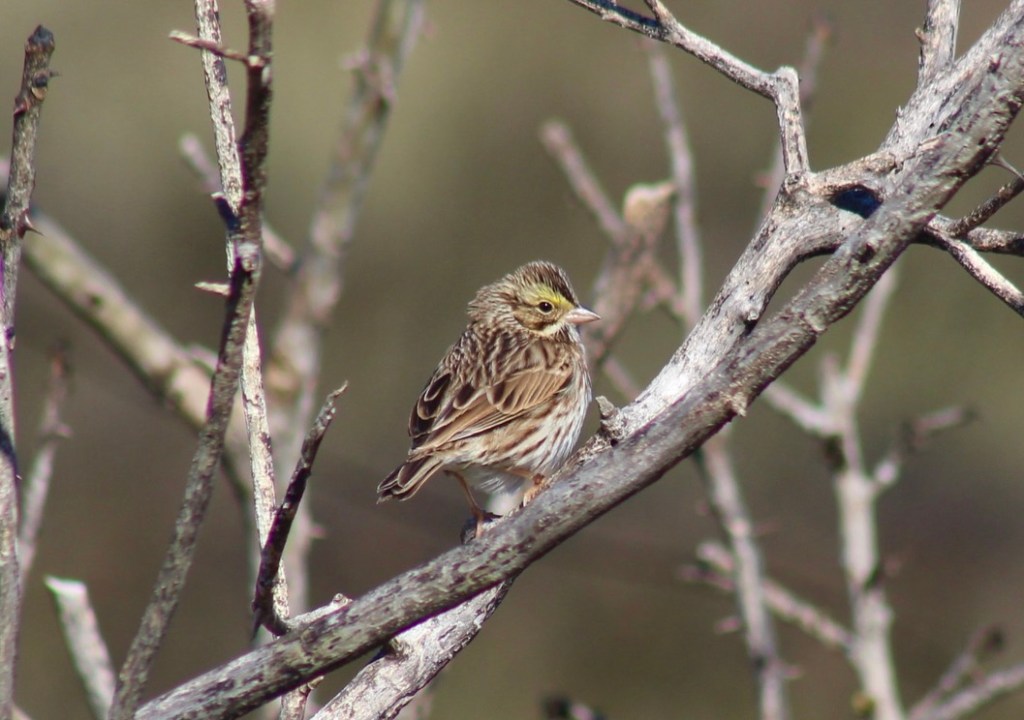
I walked along the road to visit different areas of the park which contained the most bird activity. A friendly ranger at the entrance gate gave me a small map with the most productive recent birding sites scribbled onto it in highlighter, which turned out to be quite useful to me. I started my expedition at the entrance to the park’s beach at around noon, the sunny, cold weather pleasant: around the grassy dunes that lined the beach, I soon spotted a flock of smallish passerines. It was a crisp 36 degrees Fahrenheit, balmier than morning; however, with a frigid wind gusting from the north, it felt below freezing for the duration of my outing. Unable to identify the birds by their respective species right off the bat (I knew they were sparrows), I whipped out my camera and snapped photos of one of them. This individual was perched on a dead bush, and from its cool-looking yellow supercilium I was able to determine it was a Savannah Sparrow, my first lifer of the day: one of about 44 sparrow species native to North America and the seventh sparrow species I’ve observed in the US.

Shortly after the sparrows passed me by, I continued from the dunes to a parking lot, to a shaded pavilion; I quickly noted the presence of a tyrant flycatcher in the trees overhead and took some time to observe and photograph the animal. Tyrant flycatchers, unique to the Americas, are the largest family of birds on Earth—an astounding 400 species have been described! Florida holds only a small fraction of those species, so one would think ID’ing one would be easy. However the general similarity of the species in the family leads to confusion when telling them apart. Thank God for my 600-page National Geographic guide to the birds of North America I had handy during my outing: I was able to rule out that the species I saw was an adolescent Eastern Phoebe.

Right after the flycatcher flew off, I spotted a Yellow-Rumped Warbler pecking for berries under a shrub near the pavilion, my second lifer of the day. New World warblers, or parulids, are a colorful family of birds which have a high diversity of species native to the US. Like tyrant flycatchers, they are restricted to the Americas.

It was about 12:30 when I started walking down the main road on my way to other birding grounds, having amassed probably 7-8 species at that point. The cold spell had chased most of the usual beachgoing crowd away, which allowed me to enjoy the serene coastal, natural landscapes of Anastasia as I walked. Brown Pelicans were quite common throughout my outing, in addition to egrets and gulls. An Anhinga, a cormorant-looking, yet unrelated species of bird in the darter family, flew overhead as I strolled by the outskirts of Salt Run. Salt Run is a marshy bay within the park, fringed by Black Mangroves, and during low tide the it becomes a mudflat. Interestingly enough, the St. Augustine region contains some of the northernmost mangrove forests on Earth.
Salt Run, like other mudflats I’ve birded at, provides food for many migratory and local waders, birds of prey and waterfowl. At around 1, I started up the trail that circumvents parts of the bay. The area was populated by waterbirds and, to my pleasant surprise, had very few humans. In the 45 minutes I took to complete the trail and observe the birds around it, I noted Little and Great Blue Herons, an Osprey flying off with a freshly-caught fish, a Ruddy Turnstone (a species of sandpiper), a Semipalmated Plover, a Gray Plover, a couple Snowy Egrets, and some gulls and pelicans.


I returned to the main road and made my way to another area I had yet to see: an area of maritime hammock: coastal forest composed of Slash Pines, Southern Live Oak, Palmetto and Magnolia, among many other tree and shrub species. It was eerie walking through this type of forest: the curved, elongated branches of live oaks dripping in Spanish Moss, suspended over a sea of palmetto leaves. However, it was also quite pretty and a unique landscape found only in this area of the country.
I took about an hour and a half strolling through this forest, including the time it took for me to eat my picnic lunch and the time it took for me to return to the main road after becoming lost. Other than this Red-Bellied Woodpecker and a Black-and-White Warbler, bird activity was light in the forest.


My dad generously agreed to pick me up from my outing at 4pm at the beach area, so as it was about 3:15, I headed off toward the entrance. The tide was outgoing at Salt Run, and I noted a lot of White Ibis activity in the area, so I stayed for a little while to watch these uniquely shaped waders forage for food. There was a flock of about 20 not too far from me, using their elongated, curved bills to peck around for fish and crustaceans left behind as the water drained out of the bay.


In the 15 minutes I spent observing the flock, the birds found some interesting things in the mud. One grappled with a 2 foot long eel, taking about 5 minutes to swallow the wriggling serpentine creature, which was a really unusual and interesting site! Another ibis startled a skate (a small stingray) in a little pool of water, but decided to leave the helpless fish alone.


As I departed the lively flock of ibis, I noted this Little Blue Heron wanting in on the tidal foraging action:

Although my outing was nearly over, Anastasia still had a few surprises left in store for me. As I neared the pavilion where I’d seen several species a few hours prior, I noted another warbler species on the roadside. It was a rather ordinary looking bird and hard to distinguish from other warblers. Despite having some difficulties with identifying the species, I determined it was a Palm Warbler, a relatively common winter migrant to Florida. It was also my third lifer of the day.

My final species of the day was this Tree Swallow: a usually swift and agile bird made sluggish by the chilly weather. It was so lethargic I was able to observe it for quite some time as it rested on the railing of a boardwalk, then proceeded to fly around but seemed to perch in the same place every time. After seeing the tree swallow, I jogged over to the beach area, and waited to be picked up. My outing ended at 4pm.


Overall, this outing was a success, with a surprising amount of species recorded given the cold weather: 23 total, including 3 I’d never seen before (lifers). The park itself was also beautiful and contained mostly intact, native vegetation and ecological communities which are always really interesting to explore. Altogether a fantastic addition to my trip to Florida.
I hope that this post was an interesting look into a unique area of the Sunshine State on a day of rarely-experienced frigid temperatures. Stay tuned for more, and thanks for reading as always!
-Bennett
Bird Species Recorded: (23 total, including 3 lifers)
Palm Warbler (Lifer)
Yellow-Rumped Warbler (Lifer)
Savannah Sparrow (Lifer)
Semipalmated Plover
Ruddy Turnstone
Gray Plover
Black-and-White Warbler
White Ibis
Eastern Phoebe
Northern Mockingbird
Little Blue Heron
Great Blue Heron
Great Egret
Snowy Egret
Brown Pelican
Herring Gull
Ring-Billed Gull
Osprey
Turkey Vulture
Tufted Titmouse
Red-Bellied Woodpecker
Anhinga
Tree Swallow
 Bennett Gardner Wildlife Watching
Leave a comment