
I’m not kidding when I say that sometimes my passion for the natural world is the only thing keeping me sane through high school!
It’s a crazy time of my life; my whole future laid out before me as a path with many difficult obstacles to overcome. The good news is I’m certain my future lies in the realm of zoology and conservation biology. No doubts there! Birding and wildlife watching, wildlife photography, and blogging are such exciting activities for me: they take me out of the chaos of high school life and into the world of nature. It’s what I spent last weekend doing! (When I wasn’t busy, obviously.) My first few months in Singapore were spent adjusting to my new school, making new friends, dating, and being involved with extracurricular activities. Because of this, I didn’t get out much to participate in my favorite hobby, apart from the birding trips I did with my now ex-girlfriend. Now that I’ve pretty much fully acclimatised to Singapore, I’ve set goals for myself to be a more active birder and better wildlife photographer, as well as to spend more time in the outdoors doing adventure and studying the ecology of different habitats.
———————————————————————————
Last Saturday, I set myself with the task of finding as many interesting species as possible at Sungei Buloh Wetland Reserve in a couple hours. In addition, I used a birding chat group on an app called Telegram (similar to Whatsapp) to locate 2 species of elusive pittas. The 4 species of pittas found in Singapore are rather evasive and there are only a few records of each species per year. The reason being that pittas aren’t resident birds (with the notable exception of the Mangrove Pitta). They migrate through here annually during the winter on their way down to Borneo and Sumatra. Captivated by photos of their beauty and their reclusive habits, Singaporean pittas were high on my birding bucket list.
On Thursday, the 12th of January, I was checking the Telegram chat during one of my not-so-fun classes, when I came across live updates on a Hooded Pitta that had been hanging out at an HDB (public housing estate) in Jurong East for a few days. This is quite unusual for a bird whose normal haunt is thick rainforest. I didn’t want to miss out on a dazzling target species and a new lifer, so I figured the perfect way to spend the afternoon after homework and working out would be to seek out the long-legged ground-hopping passerine. I arrived after a 20-minute cab drive from the northern end of the island to the HDB in Jurong. Using the directions provided on the chat group by other birders, I spent about fifteen minutes trying, (in vain), to detect the pitta, jogging in circles like a buffoon around the HDB park, with all my birding gear draped over my neck.
Thanks to a kind fellow birder who gave me an update on the bird’s location, I was able to finally locate him and the Hooded Pitta! Upon sighting the beautiful bird, I took out my brand-new Nikon Coolpix P-950 wildlife camera and started snapping away. Though the light kind of sucked as it was dusk, the pitta was very comfortable around people. I was happy to see how respectful everyone was of the bird during my hour-long observation of it.


I put away my camera after a while to study and fully appreciate the pitta. When the bird flew off to a nearby tree, I had it all to myself for a bit, and keeping a good distance away I was able to observe the intricacies of the animal’s body and its foraging behavior. I noted its iridescent blue wing bars; dark-green breast, belly and mantle; black face, throat and nape; and its cinnamon crown and crimson vent. It’s certainly a very exotic-looking bird, and an awesome new lifer! Unlike other passerines (perching birds), pittas stick to the ground, using their elongated legs and upright posture to spy insects and worms from afar, then lunging forward and nabbing the helpless bugs off the forest floor. Once it got comfortable with me around, I watched the Hooded Pitta feed for a little while. I departed the animal just after dark, thoroughly satisfied with my sighting.

On Saturday the 14th of January, I had no preexisting plans and was determined to do some birding to add to the Hooded Pitta sighting and make my weekend as bird-filled as possible. I decided from past experience that Sungei Buloh would be the best option for an outing rich in species. Due to its diversity of habitats that attract a variety of different migratory and resident birds, Sungei Buloh is undoubtedly one of the top birding destinations in Singapore. Translated into Malay, Sungei Buloh means “River of Bamboo”, which may’ve been the case in historical times, but in modern times thick bruguiera (prop-root) and ryzophora (stilt-root) mangrove has become the dominant flora here. Upon arriving at the reserve at 10:30am, I spotted my first lifer of the day by the parking lot: a Javan Munia that flew into some nearby trees, an uncommon and naturalized resident in Singapore. Note its thick beak designed for cracking open seeds.

I made my way across the bridge that arches over the Buloh Besar River, seeing the usual, common batch of monitor lizards, egrets, swallows, some Brahminy Kites and an Estuarine Crocodile. You read that right: crocodiles are pretty common here! If you go to Sungei Buloh in the morning at low tide and keep an watchful eye toward the banks of the Buloh Besar River, you have a very high chance of sighting one of these monstrous reptiles yourself! The mudflat ponds near the bridge were pretty empty this morning, apart from the usual barrage of egrets. Little Egrets, with their black bills and striking yellow toes and cranelike, elegant Great Egrets. I continued making my way around the trail that circumvents all the mudflat ponds of the reserve, sighting a bunch of common species. A fellow birder pointed out a Purple Heron on a mangrove-studded islet in one of the ponds, next to a Gray Heron grooming itself. Out on the mudflats there were some of the usual waders present at Sungei Buloh; namely Common Redshanks, Pacific Golden Plovers and Whimbrels. The outstanding quality of my new camera allows for some great bird and nature photos, even from a distance! (So much better than my old camera!)


At around 11:00, I was looking through one of the hides when a brilliant blue Collared Kingfisher made an appearance. This species of tree kingfisher is abundant in Sungei Buloh, where it can easily hunt its preferred prey of small fish and aquatic invertebrates. I wanted to test the power of my new zoom lens and automatic birding mode, so I positioned the camera on a stable ledge and got a relatively decent photo of the kingfisher from a distance (150+ feet, 50+ meters).


Afterwards, I moved onto a small freshwater pond just off the main trail fringed in secondary jungle and a number of fruit trees planted by the villagers that once inhabited the area. I immediately noticed a huge, 12-foot crocodile on the far shore. I observed it basking for about 5 minutes, when it lunged after a small animal on the far shore. I snapped a couple photos of the reptile’s toothy jaws, which were concealed by branches, then headed off.

I had heard the song of a male Pink-Necked Green Pigeon, and tracked the common yet beautiful dove down. It was feasting on the berries of a Fishtail Palm, probably its primary food source at Sungei Buloh based on the amount of individuals I’ve seen eating the berries.


By this point, it was around noon, and the heat of the day was upon me. I was exhausting my water supply, which consisted of a measly 2 half-liter bottles. Despite this, I climbed up the Tower Hide for some views of the reserve, which included panoramic vistas of all the mudflat ponds and the birds within them. I captured a Pacific Golden Plover that was foraging for aquatic invertebrates far below, showing off the power of my new lens!


I continued along until I reached a hide overlooking Buloh Island; an island composed almost entirely of mangroves, and prime real-estate for the reserve’s birds. I had been observing the resident egrets, when some fellow birders noted a flock of Blue-Throated Bee-Eaters on top of a dead tree: a lifer for me. The quality of the photos I took was pretty poor due to the sheer distance the birds were perched at, but the quality of the encounter more than made up for them. Bee-eaters; lively, insect-catching, agile relatives of kingfishers, make a great edition to Sungei Buloh’s bird community.

At about 12:30, I continued along the main trail, sighting a cheeky and bold Plantain Squirrel that made it clear I was in its territory by chirping, bobbing up and down and trying to chase me away!

My last sighting of note at Sungei Buloh was another lifer: a pair of Copper-Throated Sunbirds. At first I thought the female was of the more common Olive-Backed species, but upon seeing the very active male in a nearby mangrove tree, I was able to ID them as Copper-Throated Sunbirds. I was only able to see them for a few seconds before they departed, but they were interesting and marked my fourth lifer of the day.


I left Sungei Buloh shortly after, around 1pm, and tried and failed to get a cab, which led to me walking about 3 miles in the hot, oppressive sunlight to Kranji MRT station. On the way, I spotted a male Olive-Backed Sunbird sipping on the nectar of some flowers near to me. Though it’s a very common species in Singapore, I pulled out my camera and took a picture of it anyway.

Once I arrived at the MRT station, I ran over to the supermarket nearby, buying a full litre of coconut water. I chugged the whole thing, wiped the sweat off my brows, then got a train to Woodlands. After all this, I finally got a cab to a hawker stall near my next birding location at around 2:30. There, I ate a quick lunch of surprisingly delectable sambal stingray, washed down with two glasses of refreshing soursop juice.
My next location, another HDB at Bedok Reservoir Road, was my attempt at spotting another pitta species, a Blue-Winged, that had been making recent headlines in the birding community around Singapore. Both this pitta and the Hooded Pitta I’d seen earlier are normally skulking rainforest-dwellers. The fact that two had shown up in the middle of downtown Singapore on the same week meant that this was the perfect time for me to tick two target species in the same family over the course of a few days.
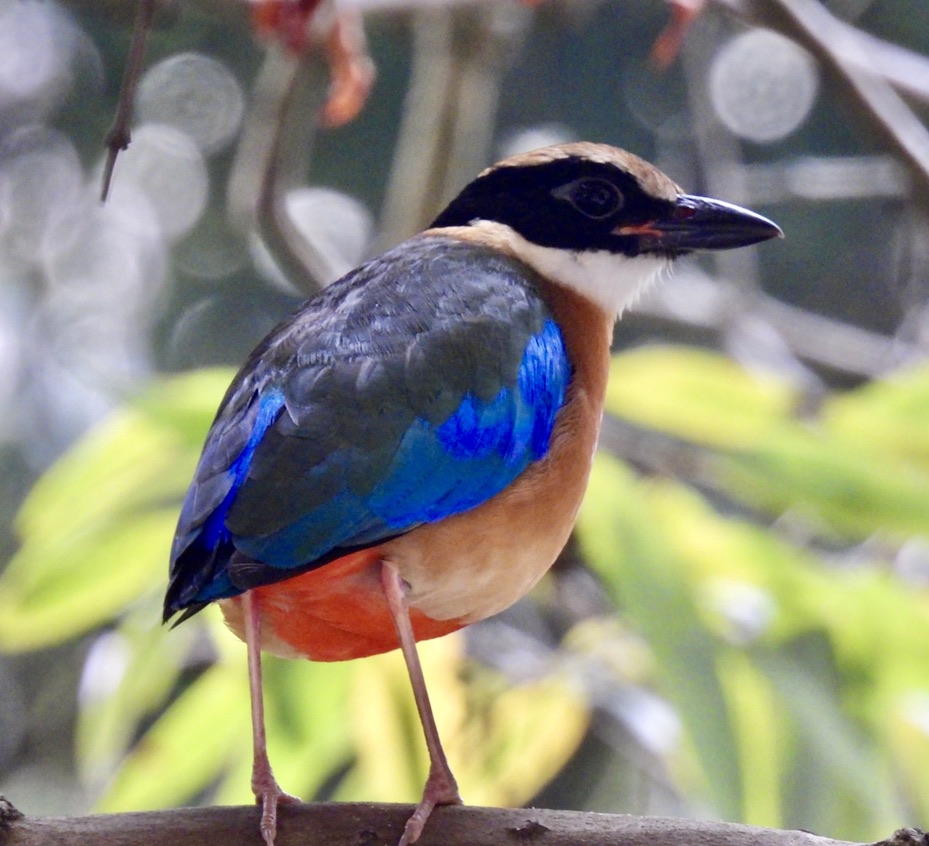
After my lunch, I got a cab from the hawker stall that dropped me off at the HDB. It had been pouring rain and thundering for half an hour before my arrival, but thankfully due to Singapore’s tropical climate, the rain was short-lived and the weather was overcast by the time I reached the location of the pitta. Luckily, the bird was much easier to locate than the Hooded Pitta, mostly due to the amount of birders and photographers crowded around the tree where it was resting. This was a bit disheartening, as the pitta, I could only imagine, was quite stressed with the amount of people constantly barraging it.


I at first couldn’t make out the bird’s location, but a nice lady helped point it out in a tangled, hidden area of the tree. We were all waiting for it to swoop down to the ground so we could observe it better and get good shots of it. In the meantime, a juvenile Tiger Shrike, a lifer for me, and another unusual species to show up at an HDB, was resting on a branch. It then proceeded to dive to the grass below to feed on an earthworm, then flew back to the pitta tree to a more secluded area where it was hard to spot.


Finally, after twenty minutes of waiting, the Blue-Winged Pitta finally appeared on a conspicuous branch of the tree, where photography was easy. The birders around me with gargantuan lenses mounted on tripods, or maneuvered by hand were clicking nonstop. I tried my hand at pitta photography, which wasn’t too hard given the bird’s tame-ish demeanor. What a beautiful species! I would say equal to the Hooded Pitta in its bright, exotic colors and interesting behavior. Together, these two pitta species have to be some of my favorite birds I’ve seen in Singapore thus far!


People came and went from the tree as the pitta flew back and forth from the branch to the ground, but I stayed and watched the beautiful, rather uncommon animal for over an hour. Afterwards, I again failed to get a cab, so I had to rely on my parents to pick me up! Thanks, guys, for bailing me out. By this point, it was around 6pm and I had succeeded in a full day of birding, with 30 species and 5 lifers recorded! Not a bad day…..
Over the course of the weekend, including the Hooded Pitta, my list stood at 31 species, 6 lifers and 2 target species; my best total for Singapore ever. I am very pleased with last weekend’s bird haul, and for the fact that I fit 3 seperate outings into 2 days. I love getting out into nature, period, but to get out and pursue one of my favorite hobbies, birding, for multiple days during the weekend is always great.
Additionally, based on my experience so far with my new camera, I am super excited to continue using it in the field to improve my wildlife photography. Anyway, thanks for reading and I am stoked to embark on more birding outings in the near future!
-Bennett
Bird Species Recorded: (31 total, including 6 lifers)
Blue-Winged Pitta (Lifer)
Hooded Pitta (Lifer)
Tiger Shrike (Lifer)
Blue-Throated Bee-Eater (Lifer)
Copper-Throated Sunbird (Lifer)
Javan Munia (Lifer)
Brahminy Kite
Yellow-Vented Bulbul
Zebra Dove
Spotted Dove
Pink-Necked Green Pigeon
White-Breasted Waterhen
Eurasian Tree Sparrow
House Crow
Asian Koel
Olive-Backed Sunbird
Black-Naped Oriole
Collared Kingfisher
Gray Heron
Purple Heron
Great Egret
Little Egret
Pacific Golden Plover
Common Redshank
Whimbrel
Asian Glossy Starling
Rock Pigeon
Pacific Swallow
Barn Swallow
Milky Stork
Javan Myna
Mammal Species Recorded: (1 total)
Plantain Squirrel
 Bennett Gardner Wildlife Watching
Leave a comment