
Sometimes a shorter birding outing is really what I need, as opposed to a half-day species and rarities haul. With schoolwork and studying consuming most of my time lately, I’ve been having less and less energy for bigger birding expeditions. Not to worry though, I’m still in the market for birding when I can get out.
This post also marks the 1-year anniversary of this blog! Thank you for the support over the past 12 months: it’s been greatly appreciated by me. I hope to continue writing posts into the far-future.
This past Saturday, the 7th of February, I embarked on a short, simple, no strings-attached birding trip to Pasir Ris Farmway 1: a landscape so unlike any other in Singapore and so similar in appearance to a favorite birding location of mine in Hong Kong, that I’ve dubbed it “Singapore’s Mai Po”. Though it was raining pretty hard the whole time, meaning my photos were, for the most part, pretty crappy, it was a cool exploration of a new birding site. And I nabbed a couple lifers despite the weather.

When I had arrived at Pasir Ris Park toward the middle of the day, a line of rainstorms tracking across Malaysia rolled in. The heavens opened and everything became dreary, wet and extremely humid. As someone with glasses, rain and humidity together are always kind of irritating. Wiping my glasses to remove raindrops and condensation, putting them on again, finding out the lenses are smeared, taking them off, wiping them again, then putting the damn things on again, only to repeat the same process five minutes later……
One bonus was the reduction in air temperature—Singapore is sweltering and muggy on sunny days. I chose to walk through Pasir Ris park to reach Pasir Ris Farmway, hoping to spot some of the bird-of-prey residents of the park: Buffy Fish Owls, Crested Honey Buzzards, and Spotted Wood Owls. Too bad none were out when I visited.
As I walked through the park, the rain remained unrelenting. I sheltered my camera underneath my rain jacket to avoid getting it wet; I managed to get some shots of some soaked common birds I passed by. I did note the large population of inquisitive Red Junglefowl x Chicken Hybrids in the park.


I followed the road that brings construction vehicles and birders to the farmway. At the end of the road was a series of run-down buildings enclosed by Leucaena, invasive woody shrubs originally from tropical parts of the Americas. A small trail, litter lining both sides, cuts through the shrubbery and spills out onto quite a unique landscape. Large, square-shaped artifical depressions dug in a grid-like pattern, surrounded by roads, paths and shrubland. The half-wetland half-open country habitat here as well as the artificial ponds full of waterbirds was like a miniature replica of Mai Po.

I believe Pasir Ris Farmway had been originally intended to be a large-scale aquaculture farm, but only about half of the many rectangular excavations there were filled with water. The rest were either grassland or marshland. There is a lot of construction happening in the area, for reasons I’m not sure of. In the hour and a half I spent there, probably 10 trucks full of excavated dirt rolled by. As the vast majority of birding sites I’ve visited are strictly protected by law, I wasn’t used to seeing environmental disturbances like these in important avian habitat. Despite it, much of the area was free of vehicles and only one small part of the farmway was under construction. Just like Mai Po and Long Valley, there was an abundance of both open-country and wetland birds due to their corresponding habitats being present. While there, I spotted Scaly-Breasted Munias and bulbuls alongside Striated Herons, Pacific Golden Plovers, Common Sandpipers, and egrets.


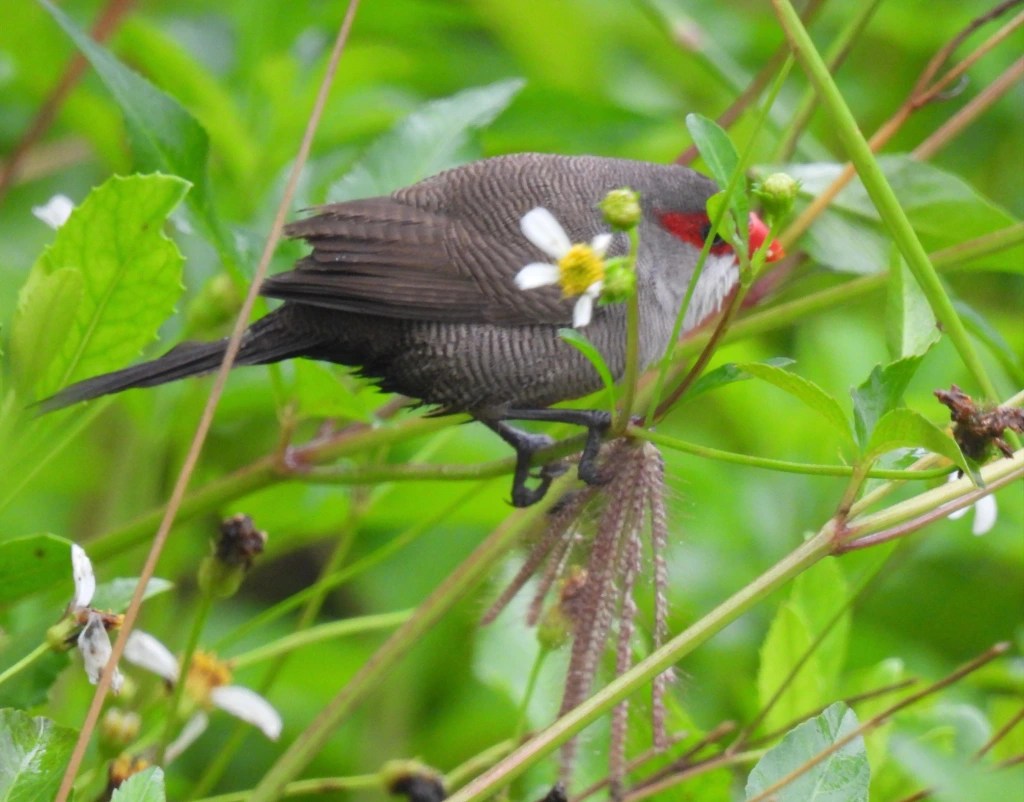
My first birds of note happened to be my only lifers of the day: a naturalized flock of Common and Black-Rumped Waxbills. The descendants of these birds were caged specimens originating from Africa that were released during local festivals as a symbol of good luck. Now they’re common, naturalized breeders throughout open country around Singapore; wherever they can get their beaks full of grass seeds, their preferred food. As both species are non-native to Singapore, I did not count them on my life list despite them being lifers.


These little Estrildid finches are lively residents of Pasir Ris and were fun to watch as they picked through a patch of brush. Not sure of their effects on native open-country birds, due to them being recent colonists of Singapore. Based on the size of the flocks I saw, it can be assumed that they are probably displacing some native species, or at the very least reducing the food available to indigenous birds with similar diets.

On the birding chat group I’m part of, some people mentioned sightings of two Little Grebes in the largest of the ponds at Pasir Ris. After the flock of waxbills flew off, I made my way to the pond where some birders were photographing the small but skilled divers. As I had seen numerous Little Grebes before in Hong Kong, to me this wasn’t a particularly interesting sighting. I snapped a few photos before checking out the rest of the farmway. The rain still hadn’t let up, and without the least bit of shelter present there, myself and my gear was becoming fully drenched.

I decided to leave the farmway after looking for some of the kingfisher species present there and having no luck. Before I left I checked the pond once more, seeing both the grebes and some Lesser Whistling Ducks.

Given the weather, this was actually a pretty productive outing. It’s not that often you find unprotected areas of land like Pasir Ris Farmway that still retain biodiversity. I’m glad I had the chance to check out this mosaic of terrestrial and aquatic habitats and birdlife. I look forward to coming back to Pasir Ris on a nicer day when a species that piques my interest is spotted in the vicinity. I’ll try getting out birding sometime in the next month, but with interim coming up and school assignments piling on, that might be difficult. Thanks for reading as always and for motivating me to write in this blog for a whole year!
-Bennett
Bird Species Recorded: (18 total, including 2 lifers)
Common Waxbill (Lifer)
Black-Rumped Waxbill (Lifer)
Little Grebe
Lesser Whistling Duck
Red Junglefowl x Chicken Hybird
Little Egret
Great Egret
Black-Naped Oriole
Collared Kingfisher
House Crow
Spotted Dove
Scaly-Breasted Munia
Yellow-Vented Bulbul
Asian Glossy Starling
Javan Myna
Common Sandpiper
Pacific Golden Plover
Striated Heron
 Bennett Gardner Wildlife Watching
Leave a comment