
An overnight wildlife expedition to Pulau Ubin (‘Granite Island’ in Malay) had been a long-awaited objective of mine since moving to Singapore in 2022. I’ve been to the island a limited number of times over the past two years due to its relatively remote location and a lack of free time on my part. However, these factors did not deter my lasting interest in visiting Ubin during nighttime hours, when many of the rare, threatened species I sought after were active.
Finally, on October 17th and 18th, 2024, I was able to carve out some time from my studies to spend an entire afternoon, night, and morning immersed in the wild side of Singapore’s last rural oasis. I was on a mission to seek out Pulau Ubin’s elusive furred and feathered residents— especially the locally endangered species not found anywhere else in Singapore like Mangrove Pitta, Greater Mouse-Deer, and Ashy Roundleaf Bat.
24 hours and 24km (15 miles) of walking later, and I had accomplished my goal……I saw both my target mammal species, the Greater Mouse-Deer, and my target bird species, the White-rumped Shama, along with some cool herps and a beautiful hunter’s moon!
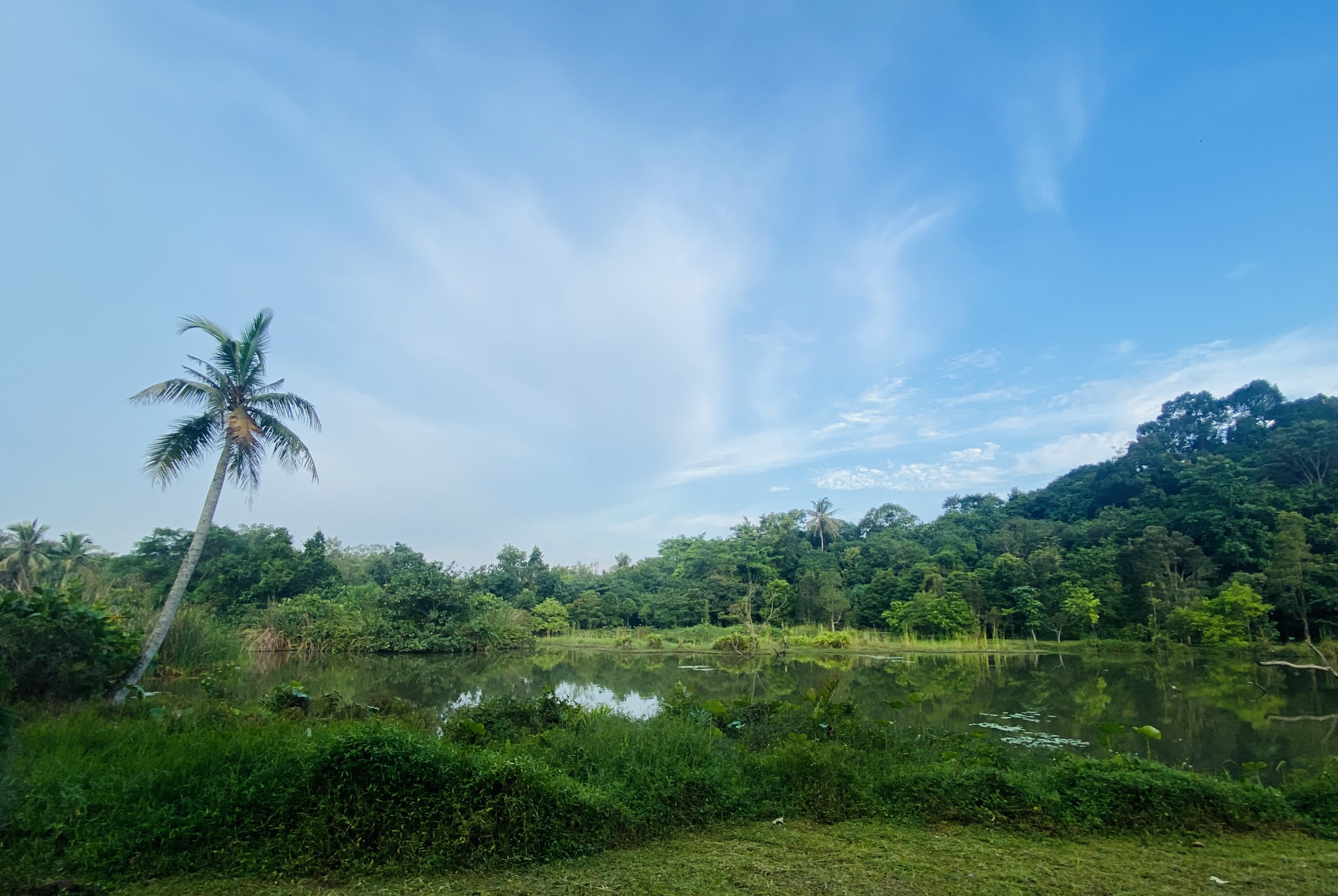
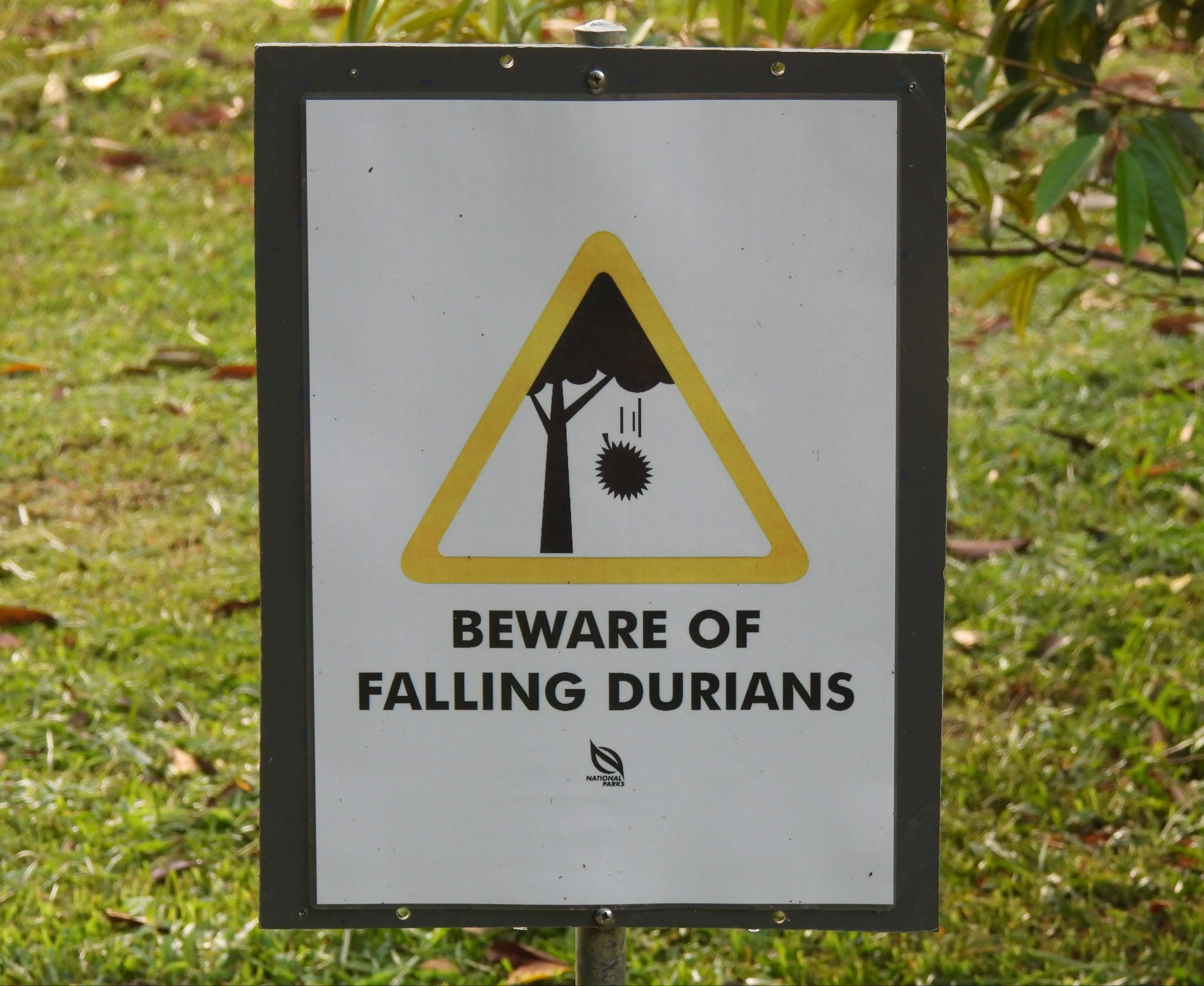
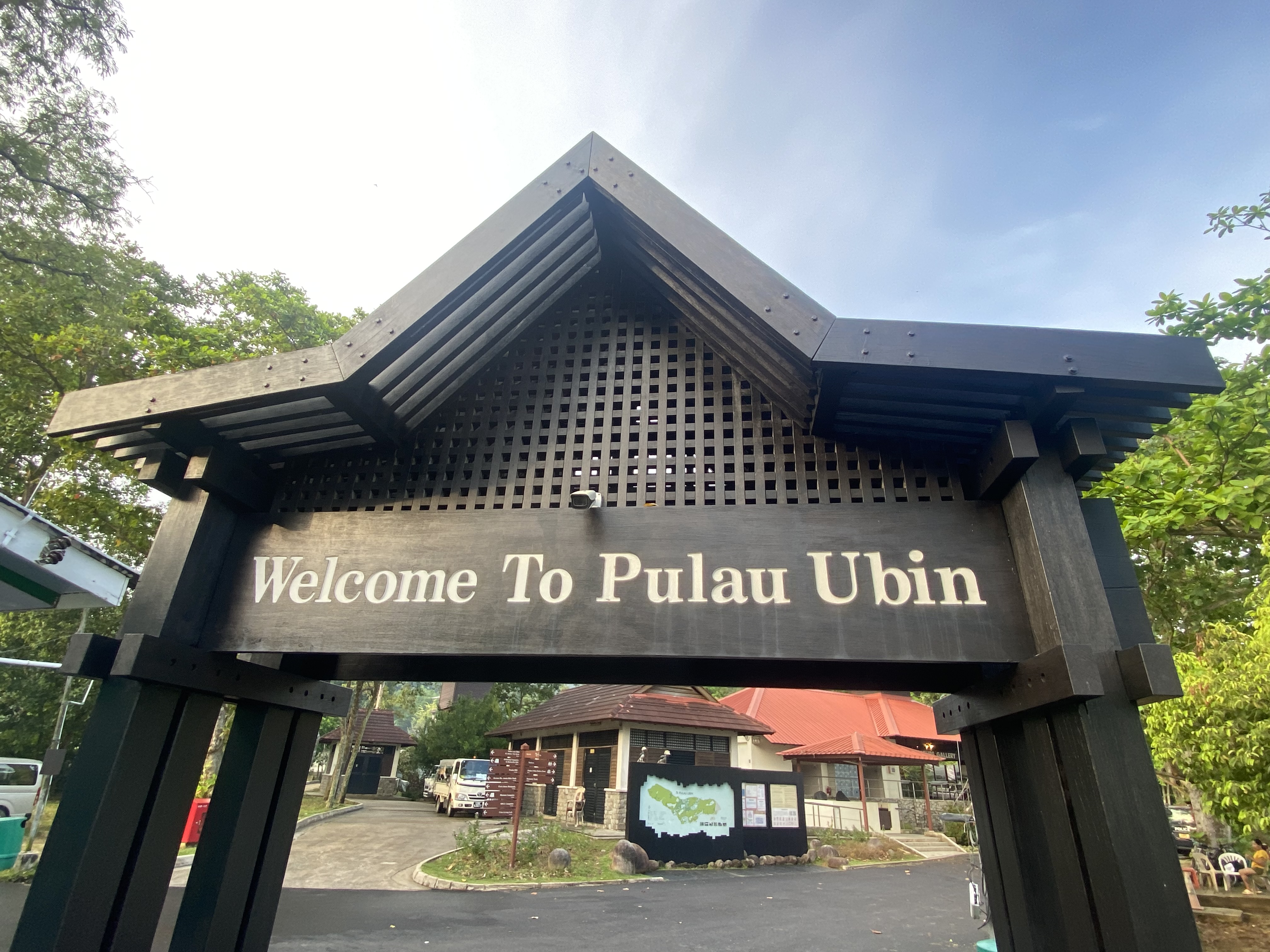
Pulau Ubin draws over 300,000 visitors annually with its abundant nature and charming Kampong settlements
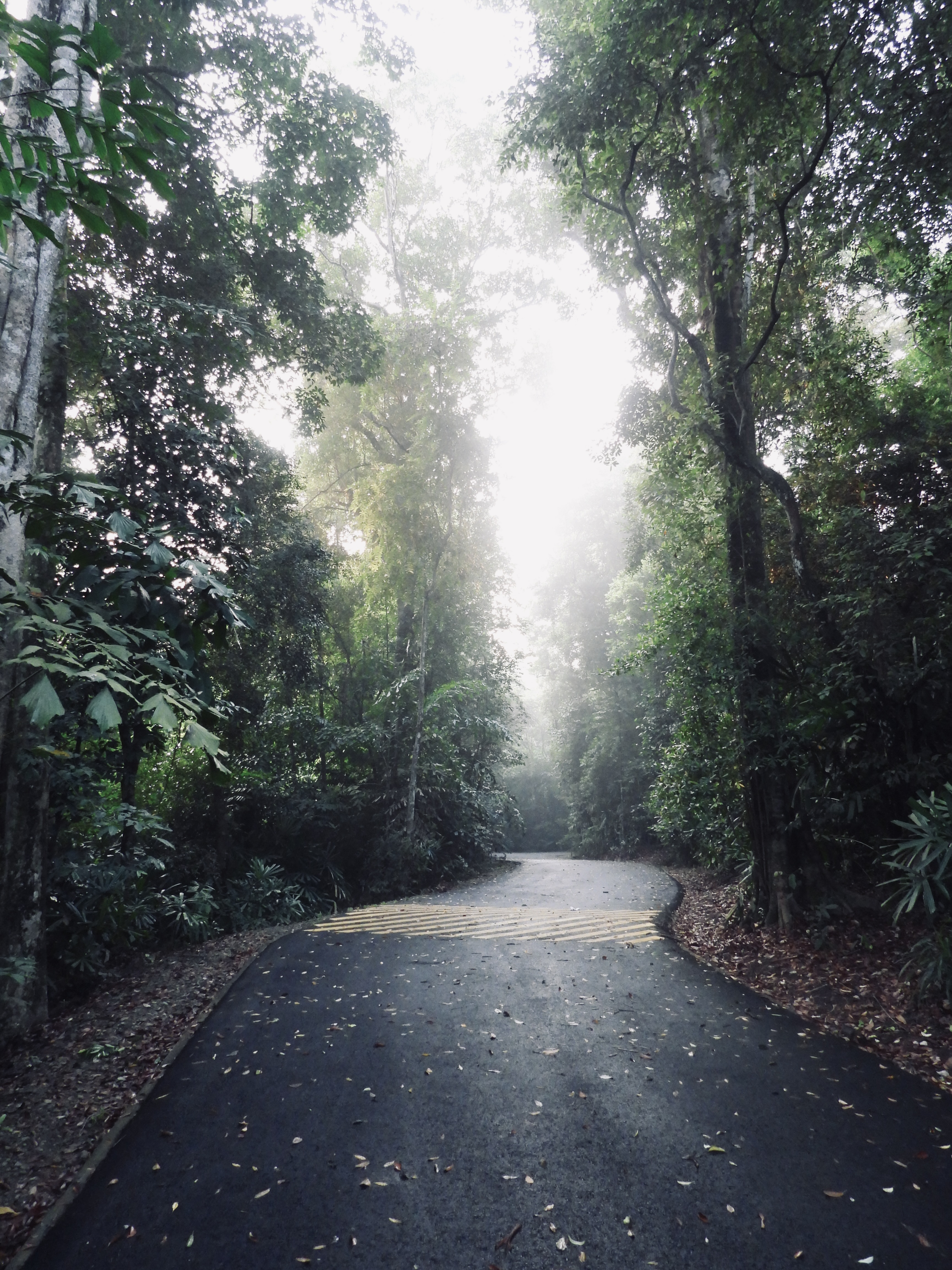

Jungle backroads of Ubin in the early morning (left), and villager-owned bumboats; the only way on and off the island (right)
I began my expedition on the afternoon of October 17th. I had spent most of the morning studying and prepping my camping gear, which had sat unused for two years since my family left Hong Kong in 2022. I headed off to Changi Village, the gateway to Pulau Ubin, around 3:00pm. In theory, this gave me enough time to get a quick dinner at Changi Village, charter a bumboat to Pulau Ubin, and make it to the island in time to walk over to my campsite and set up my tent before nightfall.
The bumboat situation ended up causing me A LOT more headache than I was expecting.
For starters, you generally need to pay the bumboat operators in cash, and my bank card wasn’t letting me withdraw any from the Changi Village ATM’s. That was frustrating enough on its own, but it gets worse. I asked the (rather rude) staff at the ferry terminal if I could pay the boat operators by scanning a PayNow QR code with my phone, and they told me it depends on the boat operator, but did not tell me which operator to go to. Finally, after asking the staff multiple times, I was directed to a boat operator who took QR code scan. At this point, it was 5:30pm, and not a single soul besides me was heading to the island, meaning I was forced to shell out a pretty penny for a single-person boat ride to the island.
Pulau Ubin bumboat operators charge a single-person fee of $48 SGD, but the amount most people pay for the trip to Ubin is generally much lower, as the boat captain divides the single-person fee by the number of people on board the boat. Since it was just me, I had to pay the full fee out of my summer savings………..I suppose this is what spur-of-the-moment planning gets you………..


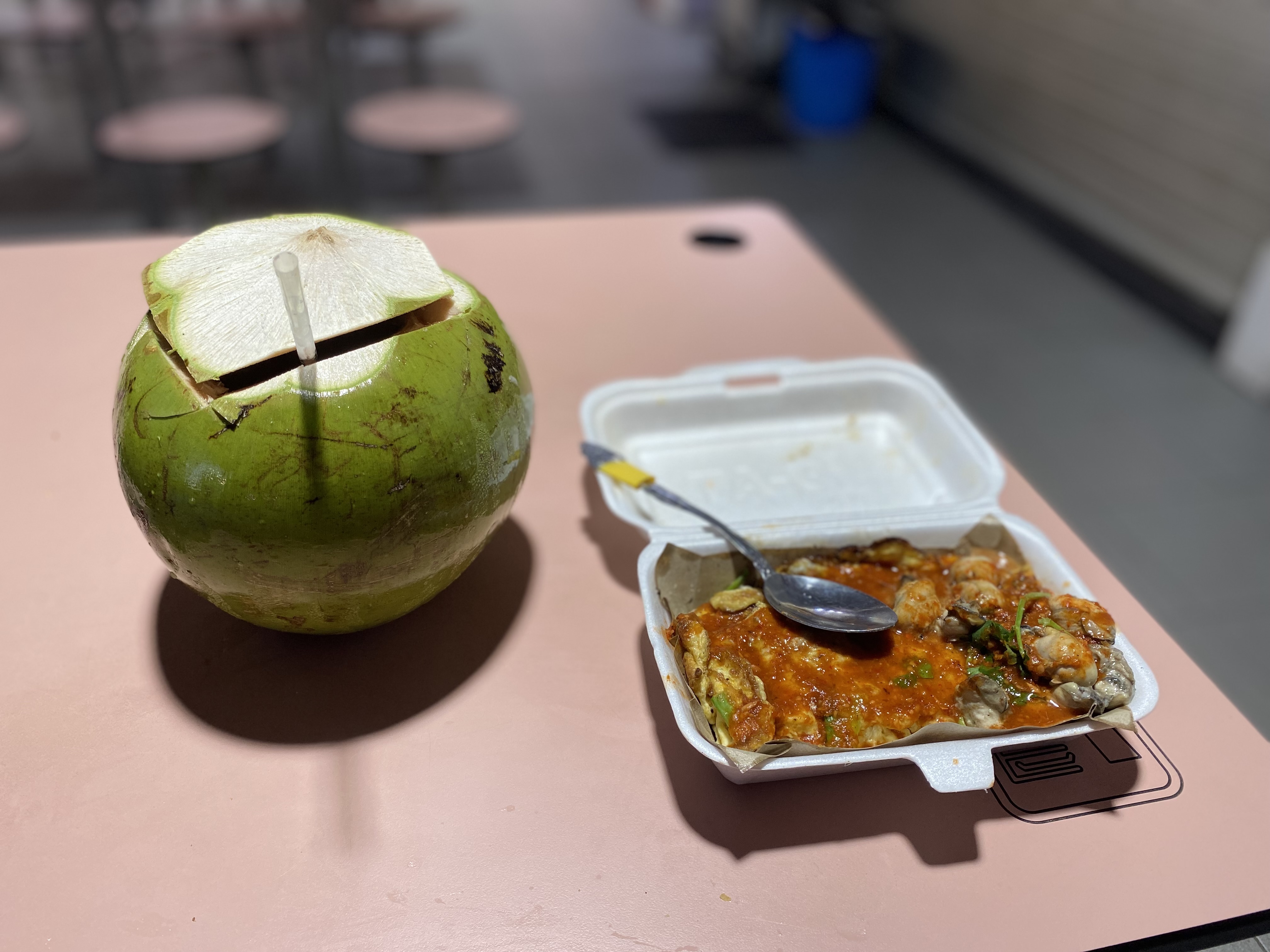

En route to Ubin (left), walking to the ferry terminal with all my gear (top right), and tasty hawker center dinner (right center)
After arriving on the island just before 6:00pm, I walked briskly toward my campsite, which was 2 miles (3 km) away on the northern shorn of Pulau Ubin. There are 3 main campsites on Ubin, and I chose the one furthest away from the ferry pier, Mamam Campsite. I thought camping in one of the more remote parts of the island would give me higher likelihood of mammal sightings in my vicinity, but this turned out to be untrue. It was still a pleasant, clean campsite with nice, panoramic views across the Strait of Singapore to the coastline of southern Johor, Malaysia.
After pitching my tent, I was treated to a once-a-year astronomical event visible at Mamam Campsite: the annual hunter’s moon. This was the largest of the four supermoons occurring throughout Singapore in 2024, and the brilliant moonlight made me wonder if I even needed to bring my spotlight on my Ubin night walk!
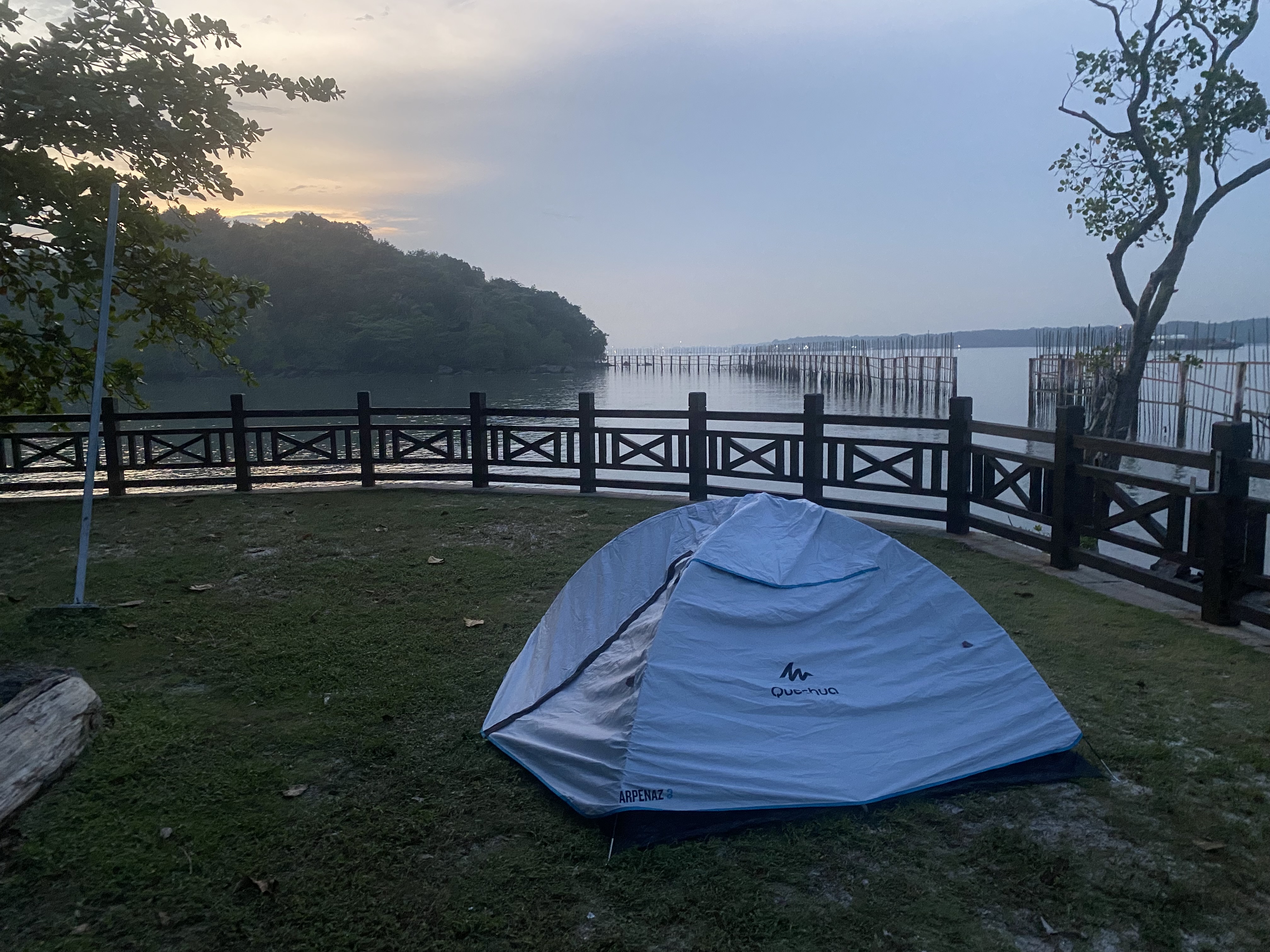

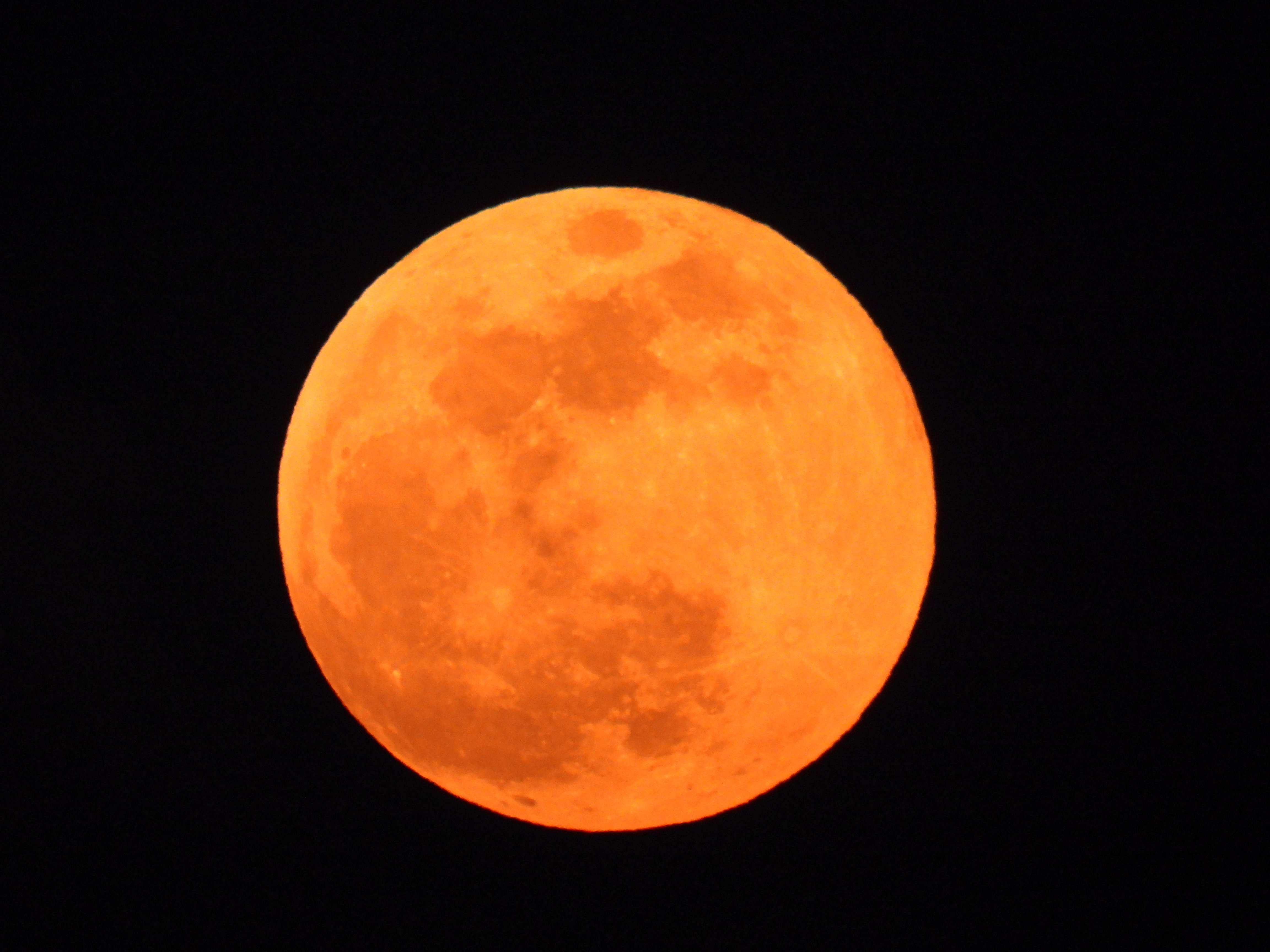
Sunset from Mamam Campsite (left), The real owners of Pulau Ubin (top right) and hunter’s moon from Mamam Campsite (bottom right)
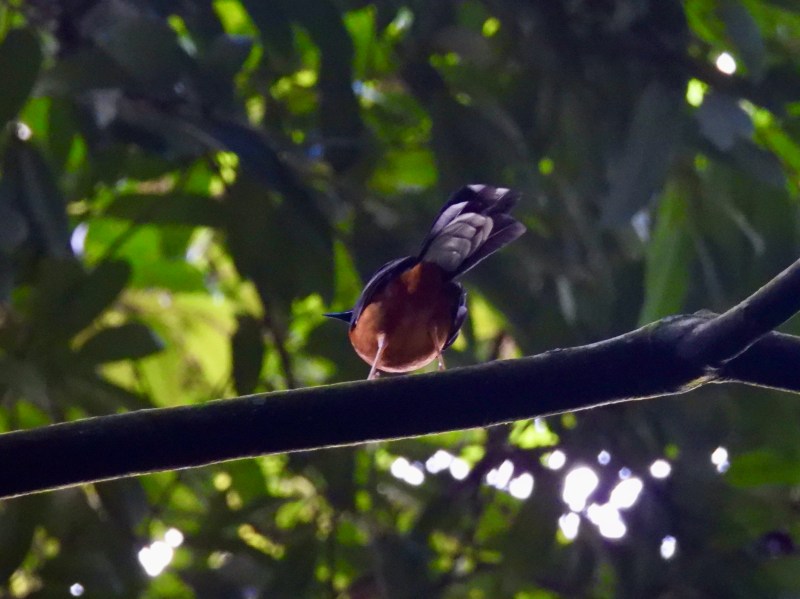
While walking to Mamam, I kept a keen eye out for birds in the trees above. I also made sure to weave around any Long-tailed Macaques foraging on the trail. My target bird species was the White-rumped Shama, a tricolored, long-tailed flycatcher with a beautiful song, that is seen regularly on Ubin. It is threatened by poaching for the cagebird trade elsewhere in Southeast Asia, and Singapore is a refuge for this species. The most reliable sightings of White-rumped Shamas in Singapore come from Pulau Ubin, and I was determined to spot one on my overnight trip.
Halfway between the pier and my campsite, I was in luck. There was the sudden chipper of birdsong in the trees around me, and I was pretty sure I was hearing White-rumped Shamas! It was hard to locate the songsters in thick rainforest at dusk, but I was patient and one of the birds came into view. Sure enough, it was my target species! The White-rumped Shama I observed was fast-moving and loud, and never stopped in one place longer than a few seconds, making it hard to snap a record shot. I only managed one passable photo of this cool species. Still, what a treat!
I pitched my tent just as the sun was slipping beneath the horizon. It had been a while since I’d gone camping, and I was a bit rusty with the tent set-up. I placed most of my gear in my tent, and finished the dinner I bought at Changi Village while watching the sun set. The hunter’s moon was an unexpected and pleasant surprise, and I enjoyed the view for several minutes before heading off on my night walk.
I planned to walk over half the length of the island that night (16 km or 10 miles), from Mamam Campsite in the northeast of Ubin, to Ketam Quarry in the southwest, and had made sure my phone and spotlight were fully charged for this ordeal.
I was primarily going after nocturnal mammals, specifically Greater Mouse-Deer. In Singapore, these tusked, diminutive, deer-like mammals are only found on Pulau Ubin, where they were rediscovered in 2008 after being marked as locally extinct in Singapore. There is now a healthy, thriving population of Greater Mouse-Deer on the island. I’ve seen plenty of this species’ relative, the Lesser Mouse-Deer, on mainland Singapore, and I wanted to try my luck at spotting both Singaporean mouse-deer!
Originally, I was just going after mammals on my night walk, but my friend Kwang informed me of spots on Pulau Ubin where normally rare snakes like the Banded Krait (Bungarus fasciatus) and Dog-toothed Cat Snake (Boiga cynodon) were seen regularly by herpers. I made special note to be on the lookout for herps throughout my walk, as there are a bunch of cool Singaporean snakes I’d like to see.
So, with my targets in mind, and a route to follow, I set off up the moonlit trail at 7:30pm.
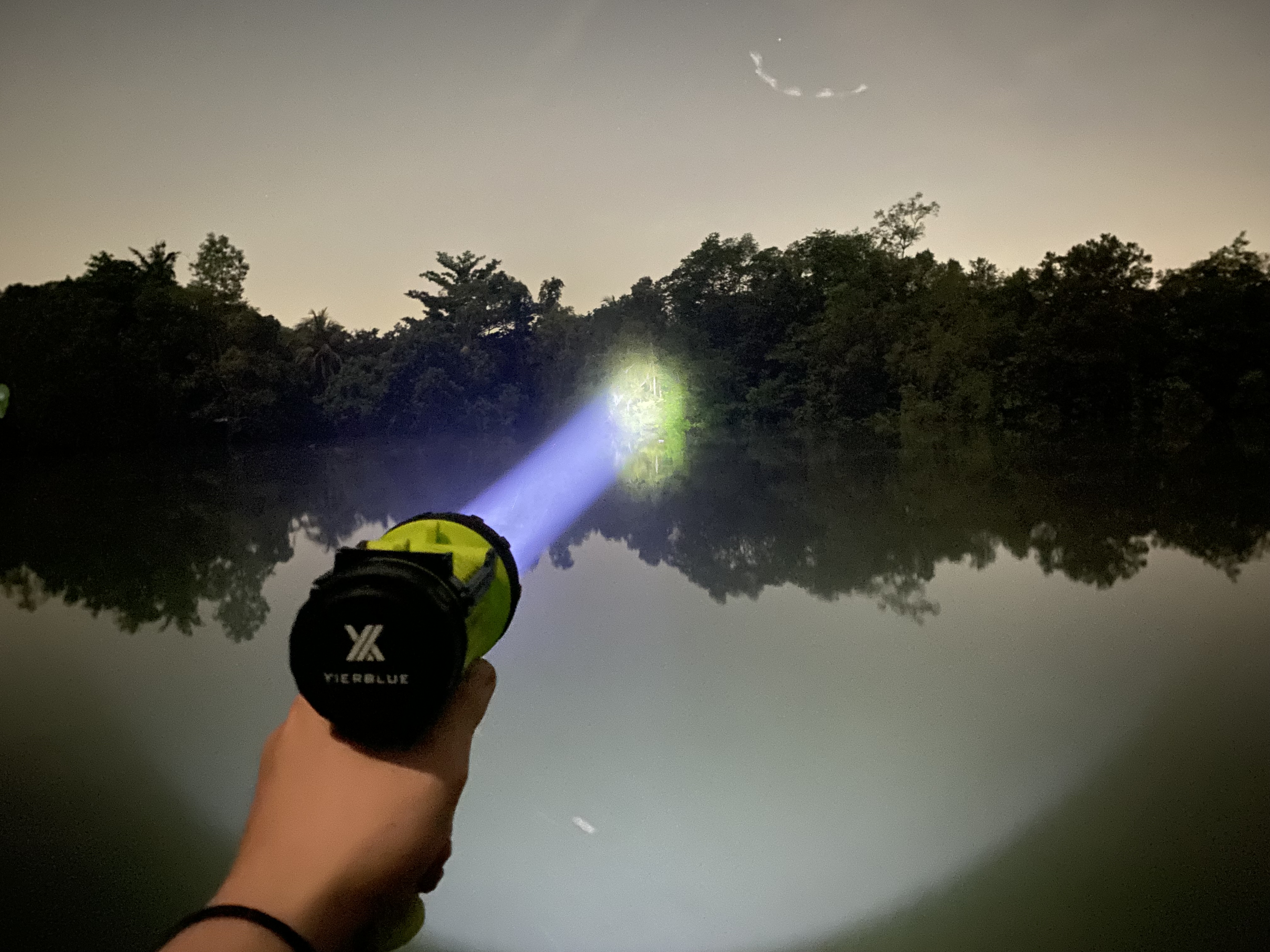


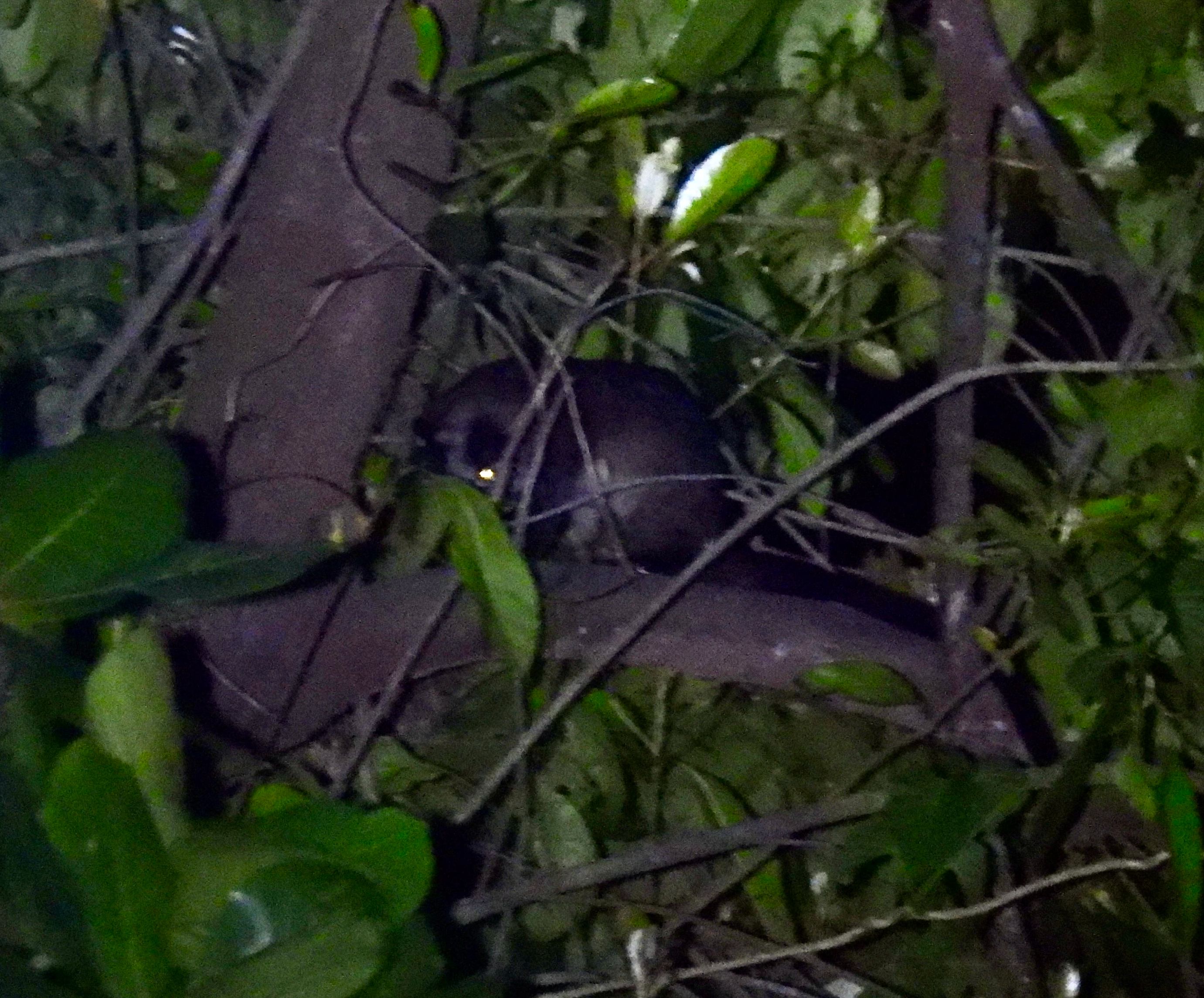
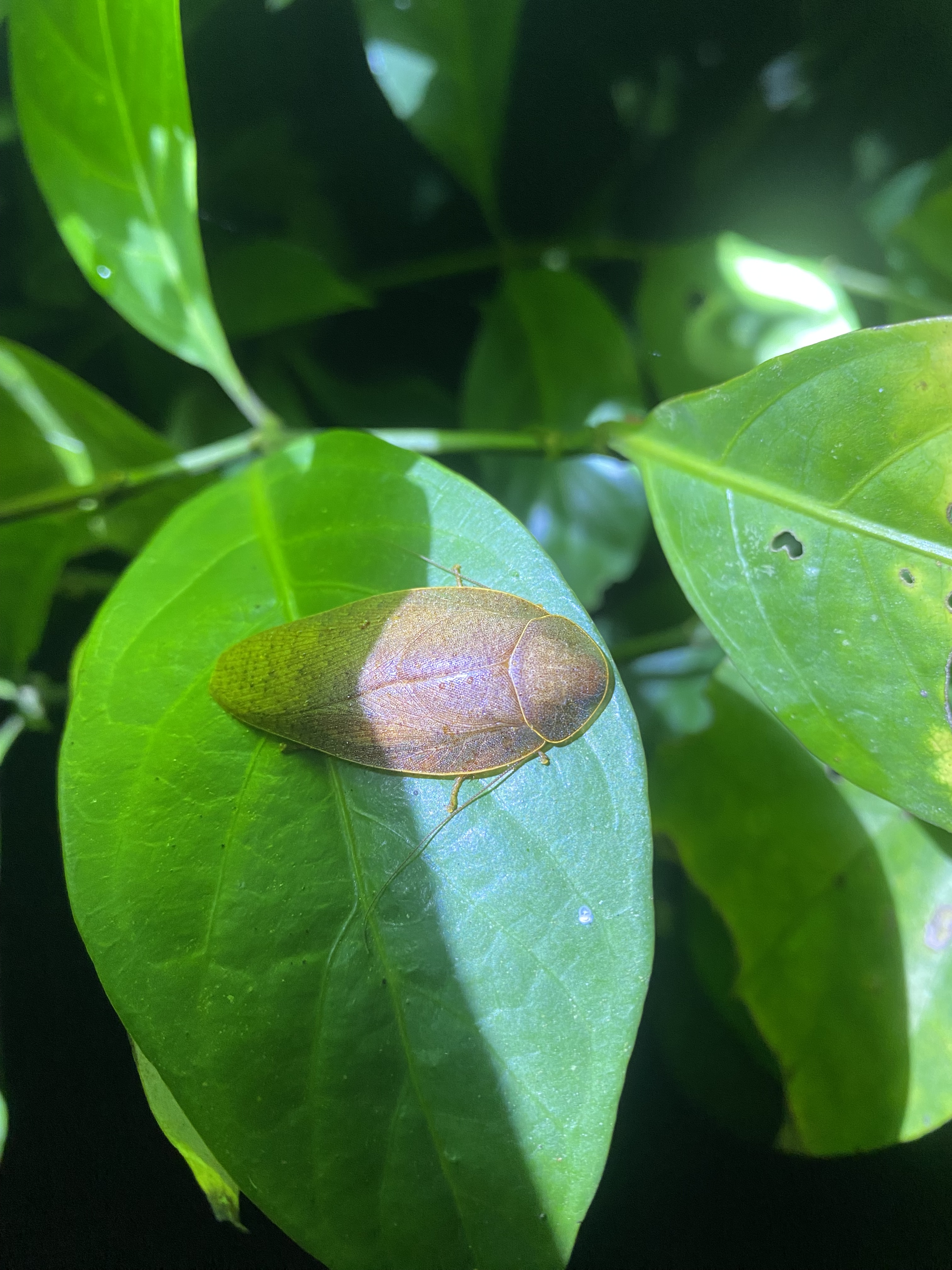
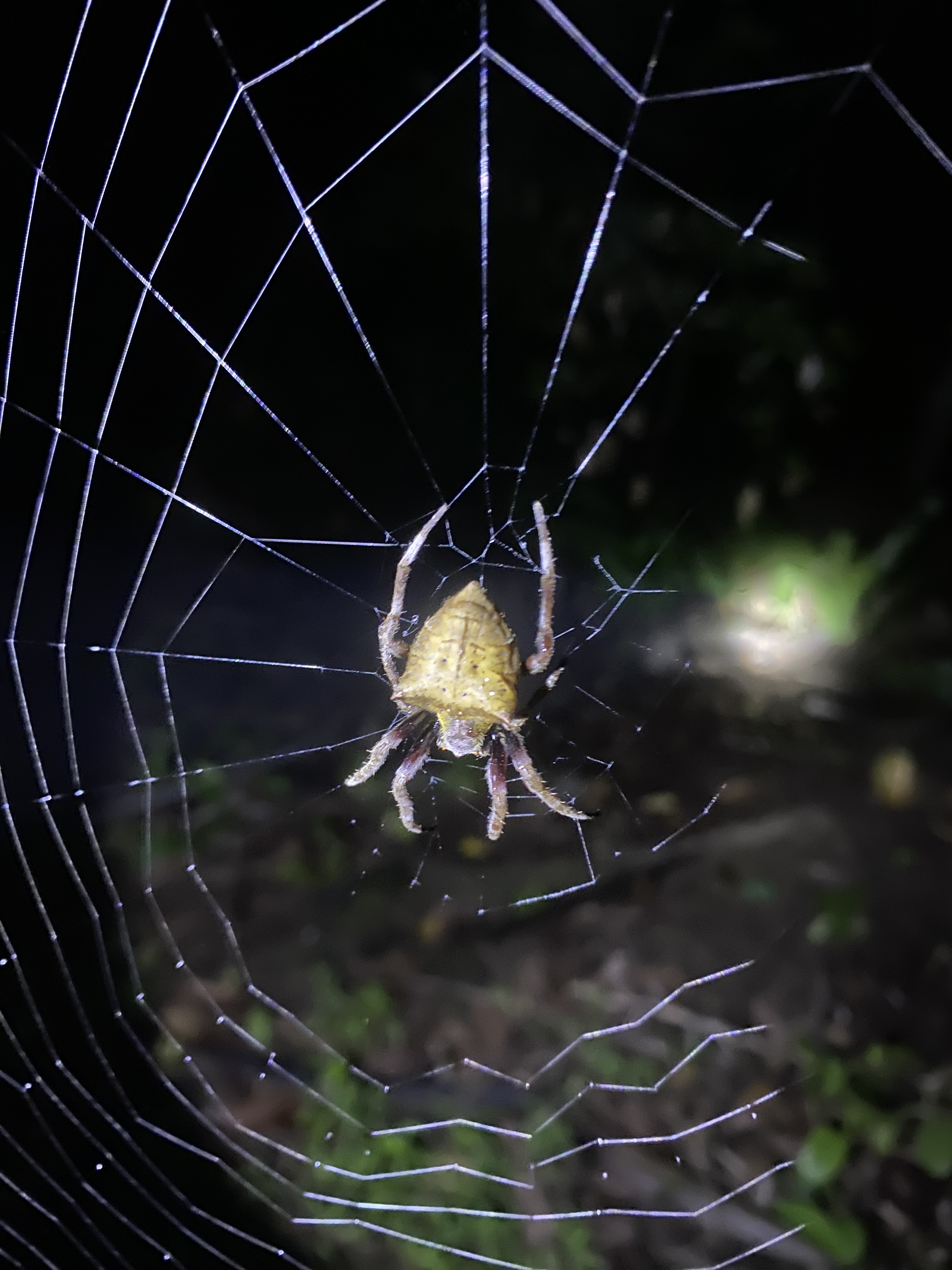
Top Row: Spotlighting the Ubin mangroves (left), possible sighting of Dark-Tailed Tree Rat (top right), and sleeping Swinhoe’s White Eye (bottom right)
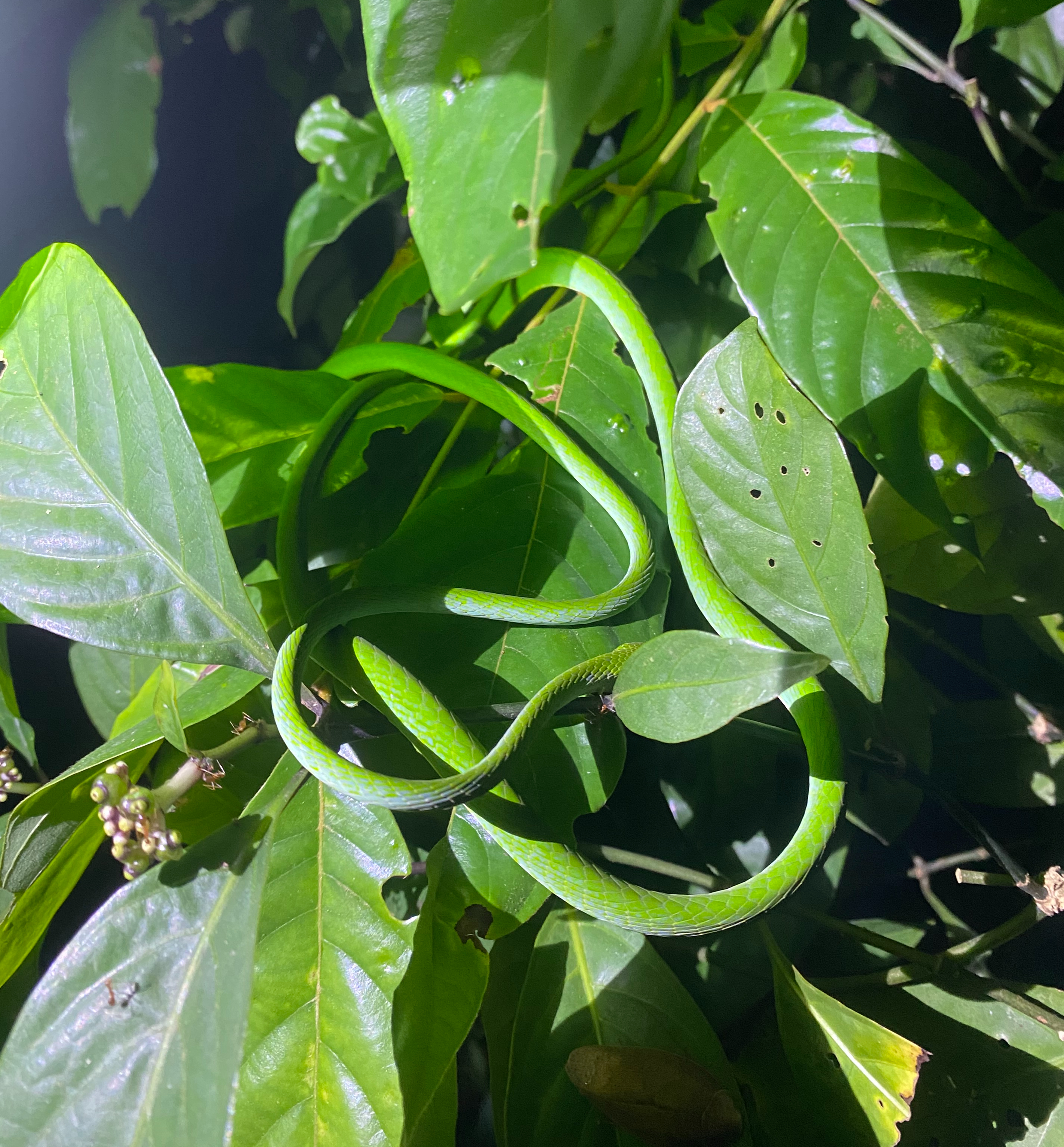
Bottom Row (left to right in order): Common Palm Civet, Oriental Whipsnake (Ahaetulla prasina), Giant Cockroach (Pseudophoraspis nebulosa), and Abandoned-Web Orb Weaver (Parawixia sp.)
My walk was long, reasonably productive, and quite arduous toward the end, when physical and mental exhaustion set in. From the time I left Mamam Campsite to when I returned was a full six hours, from 7:30pm-1:30am, and covered the entirety of the original route I’d wanted to take. I didn’t see much for the first half of my walk, and I think this was because I started spotlighting too early (many nocturnal animals come out to forage well after dusk), and also because the bright moonlight may have lessened the activity of certain nocturnal creatures.
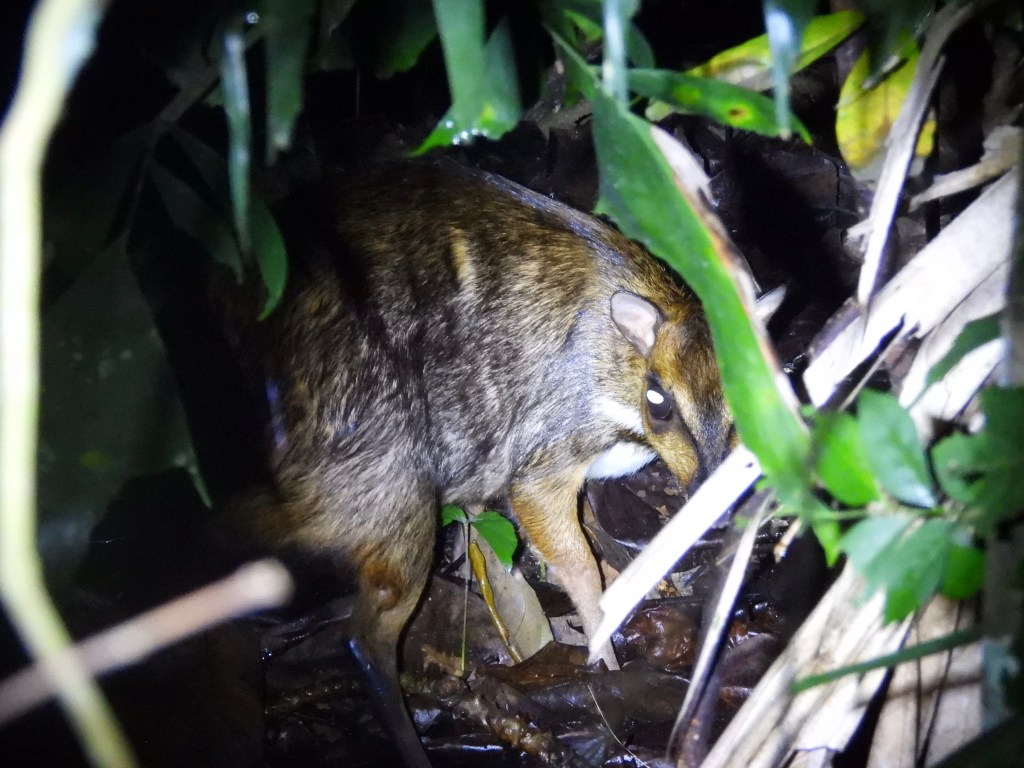
Luck was on my side for spotting mammals, though, and I saw no fewer than four Greater Mouse-Deer throughout my walk, including a pair in the shrubs right next to me! Mouse-deer are very shy animals, and the individuals that I shone my spotlight on quickly disappeared into thick vegetation. Other mammals I spotted on my walk include an arboreal rat from (I think) the genus Niviventer, possibly a Dark-tailed Tree Rat (Niviventer cremoriventer), which would make it a new record for Pulau Ubin, though I definitely can’t say so for sure. Additionally, I saw plenty of Lesser Short-nosed Fruit Bats, and also a Common Palm Civet in a tree bordering Pekan Quarry.
I had less luck with herps, and I wasn’t able to find any of the cool snake species Kwang told me about. I did, however, see four Oriental Whipsnakes (Ahaetulla prasina), and one fast-moving Banded File Snake (Acrochordus granulatus) that slithered across a tidally-flooded portion of the trail near the mangroves.
I was actually surprised about how few arthropods I came across throughout my walk; in six hours I noted only moths, Giant Cockroaches (Pseudophoraspis nebulosa), and Abandoned-Web Orb Weavers (Parawixia sp.)
Overall, it was a successful night walk, one of my best to date in Singapore, covering a huge portion of Pulau Ubin. I nabbed a couple good mammals, including my target species, and some nice herps. Next time I visit Pulau Ubin, I want to return with Kwang and focus on finding Ubin’s rare snake species. Maybe give some time for mammal spotlighting as well.
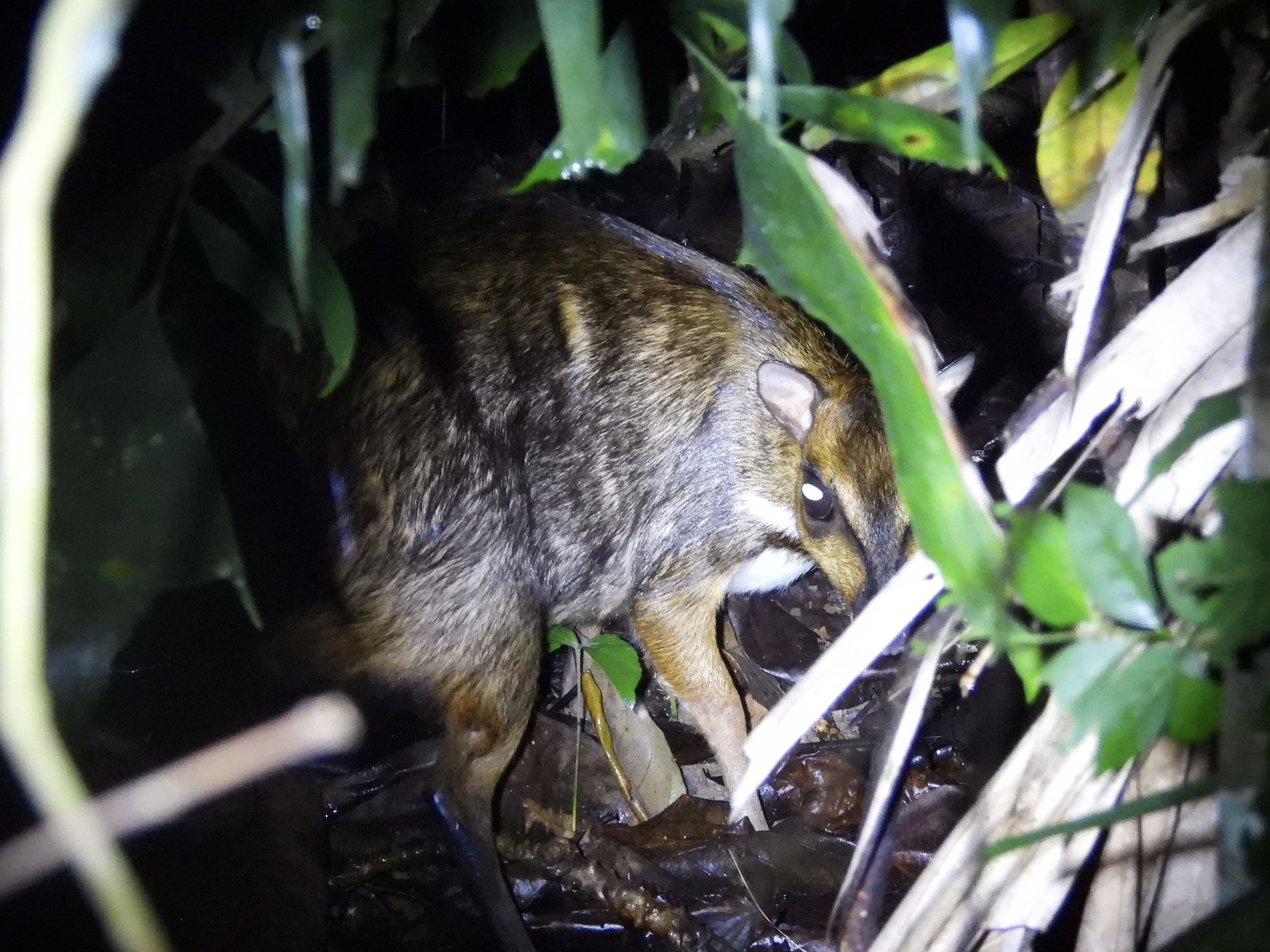
Greater Mouse-Deer
After an uncomfortable 5 hours of ‘sleep’, I packed up my tent and gear and watched the sun rise from Mamam Campsite. Still tired from the night before, I was nevertheless ready for a morning of birding.
I started walking down the trail leading to the Kampong village, the lush, steamy secondary jungle closing in around me, pulsing with birdsong and the chatter of macaques, with not a single human vehicle or voice to be heard. If it weren’t for the asphalt path beneath my feet, I’d have thought I was in the middle of a rainforested wilderness.
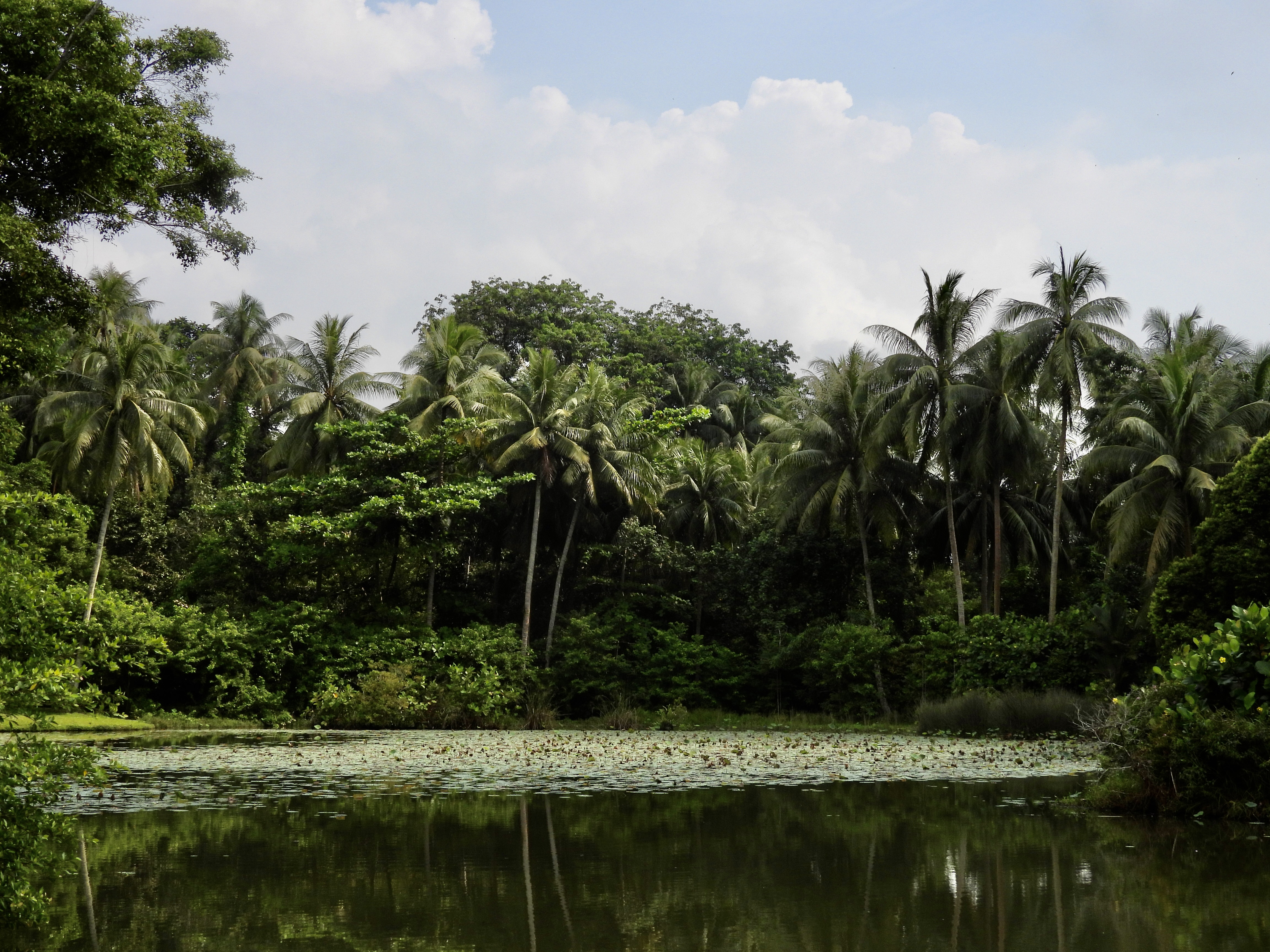
Scenes like this, in my eyes, affirm that Pulau Ubin is a ‘lost world’ of sorts, spared from the claws of urban developers on mainland Singapore. The vast majority of the 10km² (4 mile²) island is cloaked in thick mangroves and secondary rainforest, interspersed only with abandoned, water-filled granite quarries. This contiguous expanse of habitat makes Ubin a paradise for Singapore’s remaining wildlife, including imperilled Southeast Asian animals that are clinging onto life elsewhere in the region.
The island is a particularly important stronghold for the Straw-Headed Bulbul. Similar to the White-rumped Shama, Straw-headed Bulbuls are often poached from the wild for the cage bird trade due to their vibrant, melodious songs. Pulau Ubin houses nearly 20% of the global population of this critically endangered songbird. The audio file I’ve linked below is a recording of a Straw-Headed Bulbul singing from when I visited Ubin last year (October, 2023). Sorry for all the background noise!
On this particular morning on Ubin, I was hearing quite a few Straw-Headed Bulbuls in the secondary rainforest between Mamam Campsite and the Kampong village, but I struck out on seeing one despite multiple attempts at locating a singing individual. Though I missed out on seeing this endangered, noteworthy bird, I still ended my Ubin trip with 20 species including my primary avian target species.
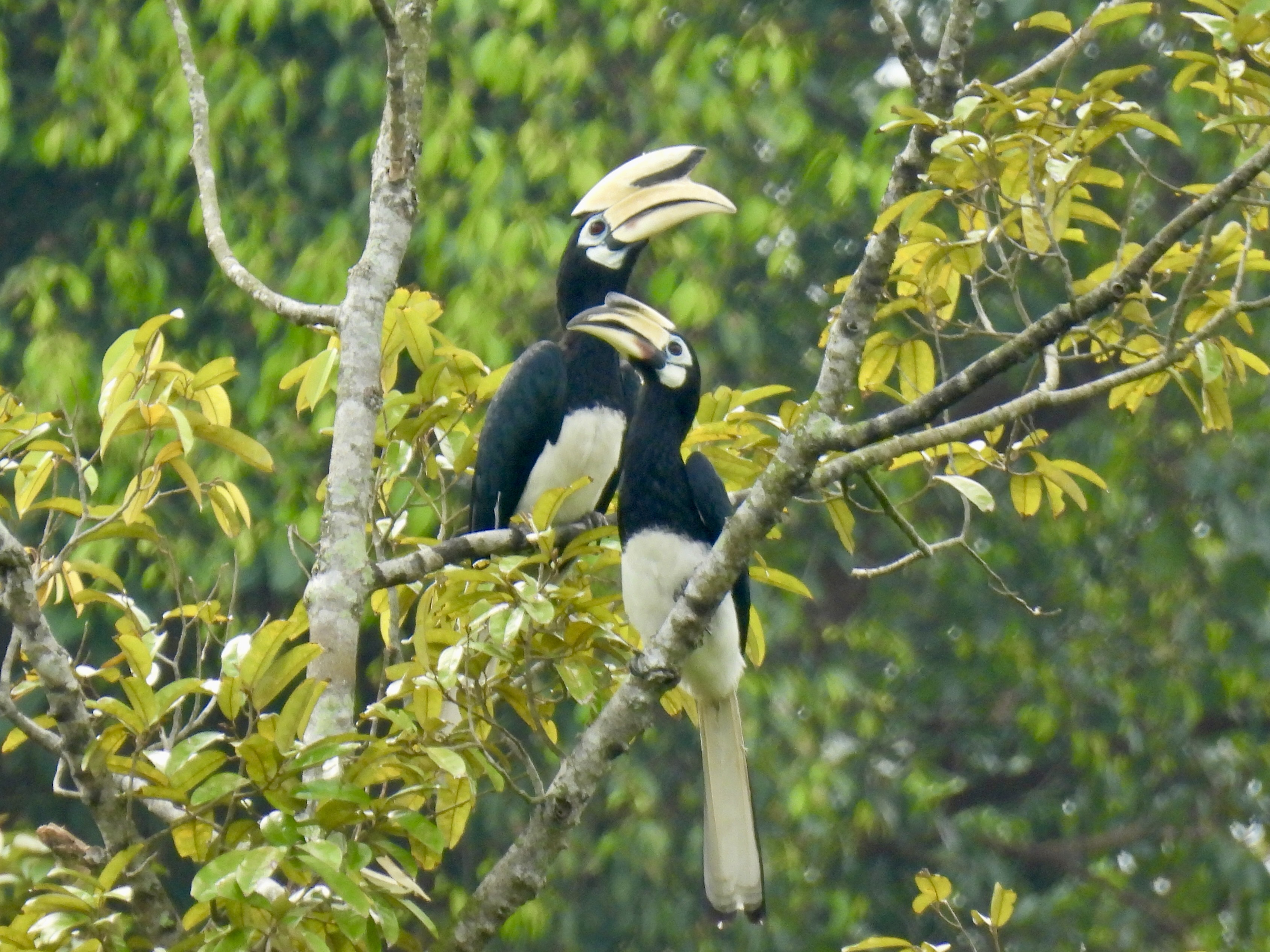
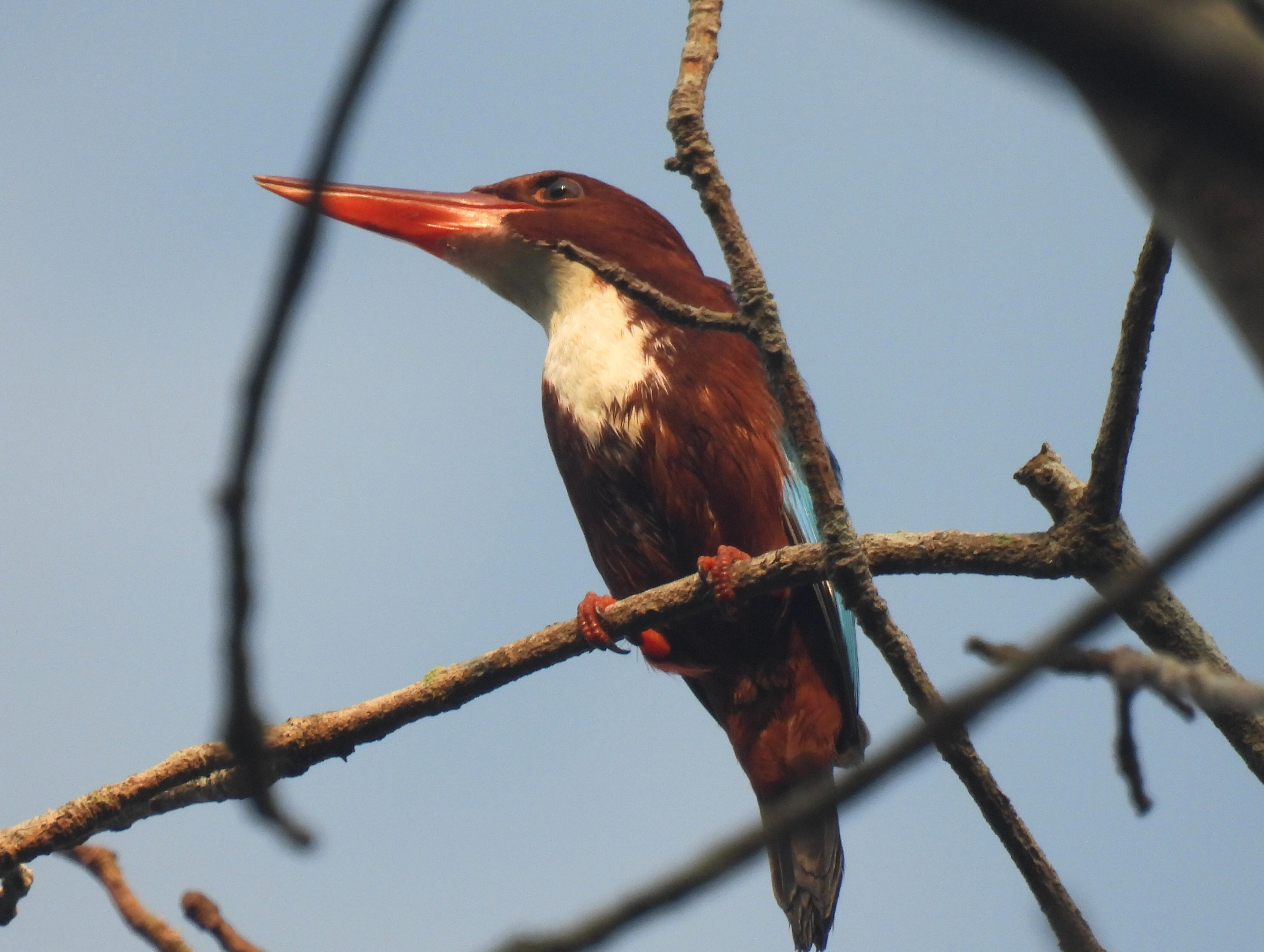
Highlight bird sightings of my October 18th morning birding session include a majestic pair of Oriental Pied Hornbills near the Kampong village, White-throated, Common, Collared, and Stork-billed Kingfishers, and a flock of Blue-tailed Bee Eaters.
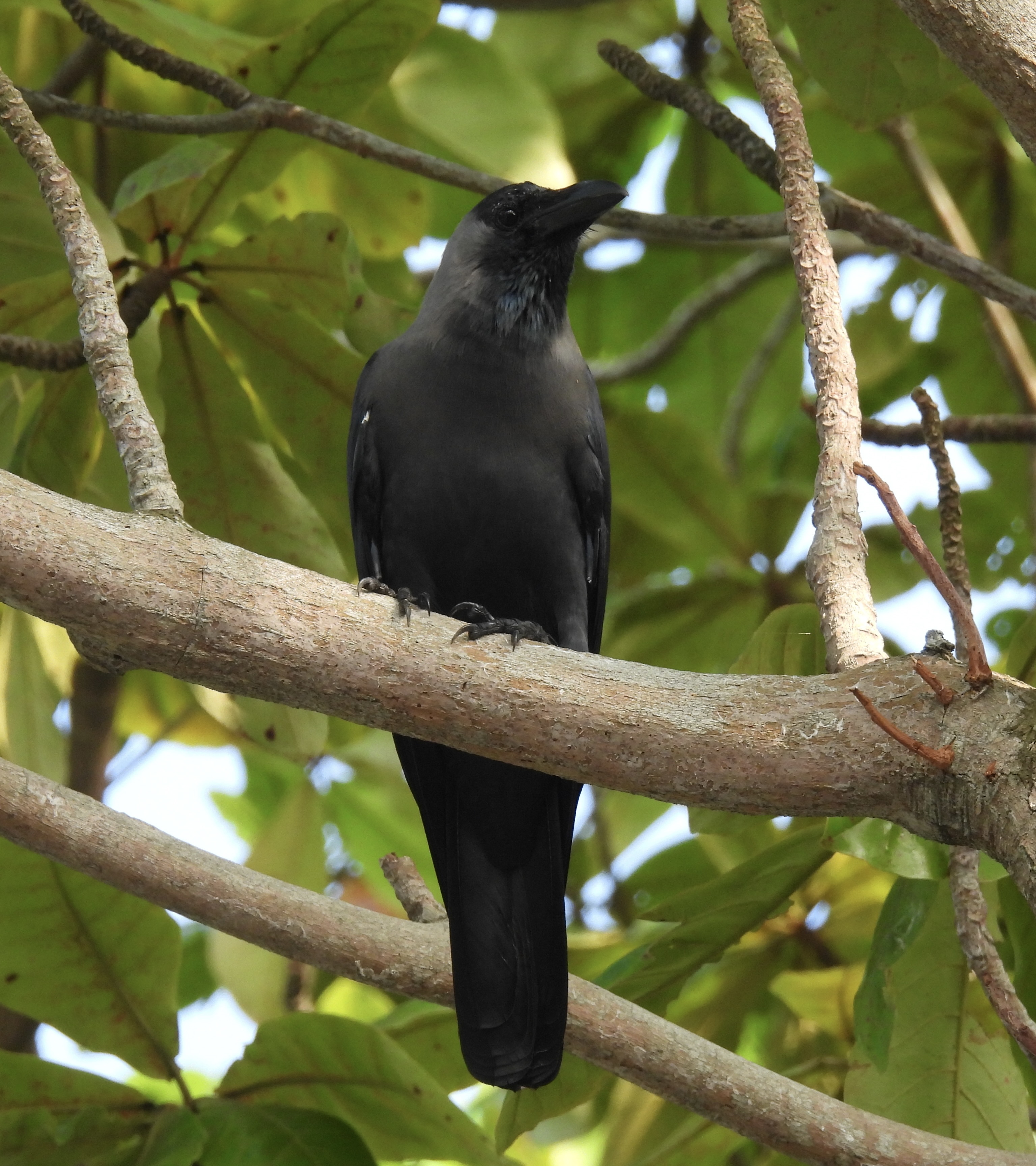
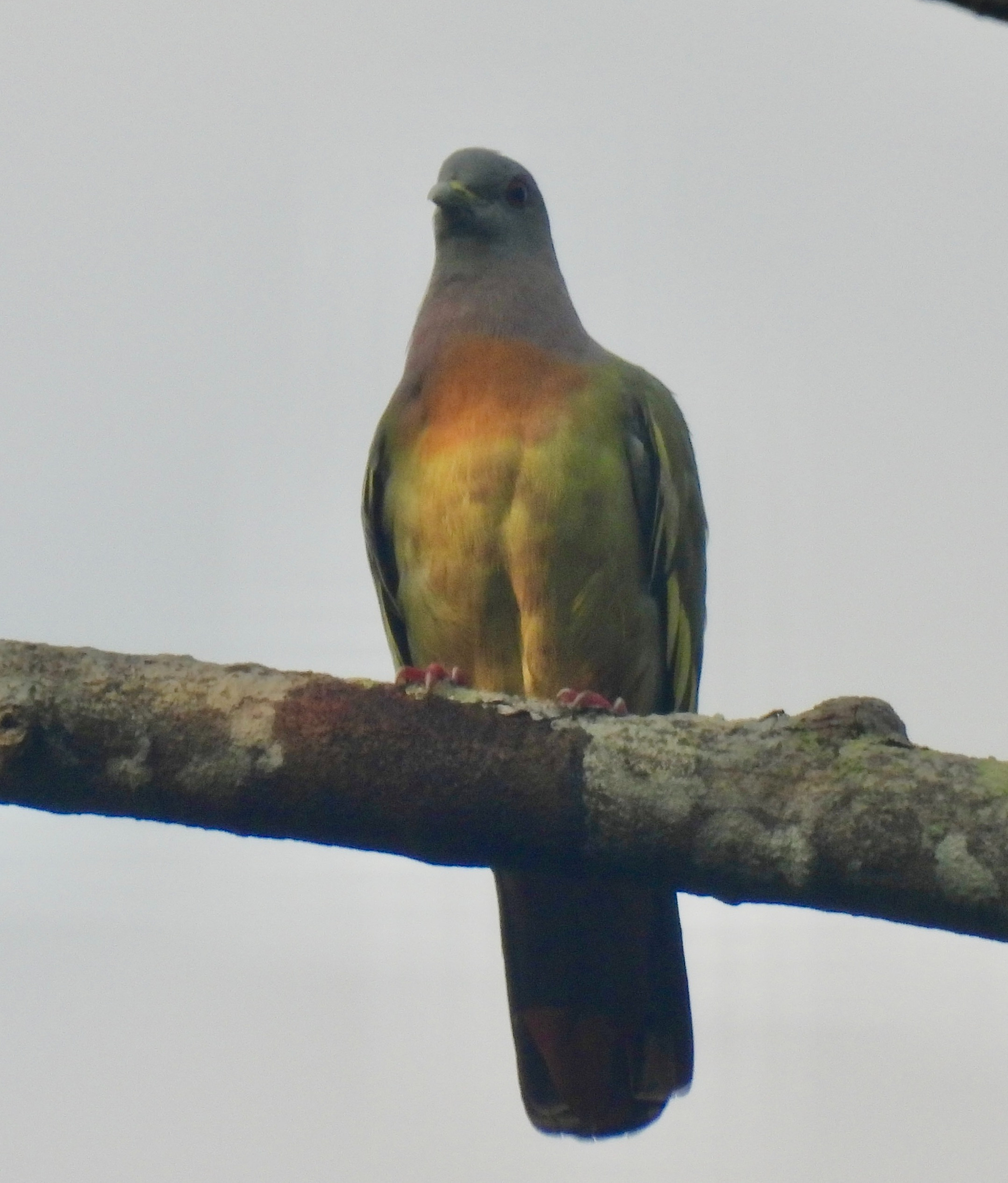
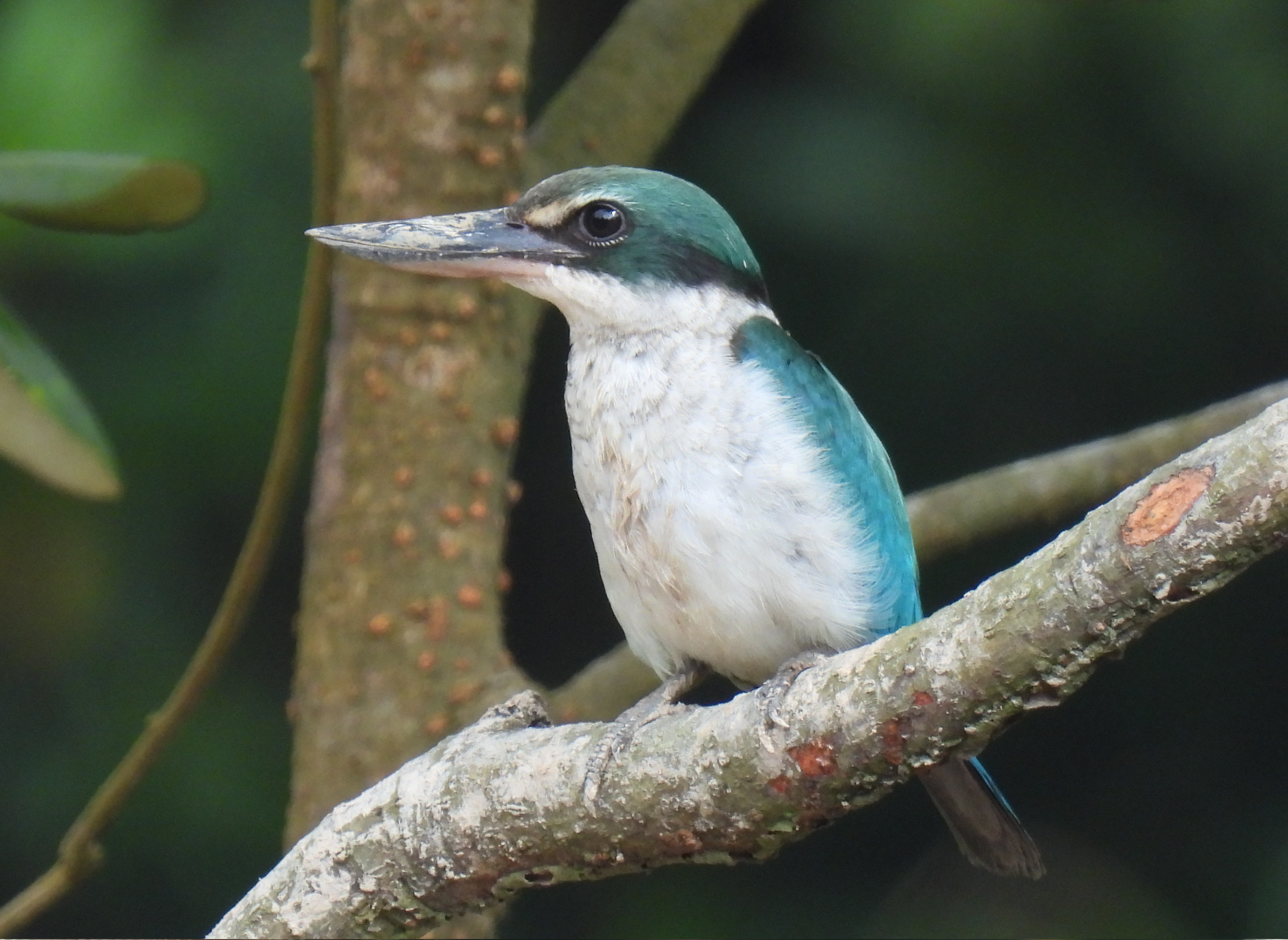
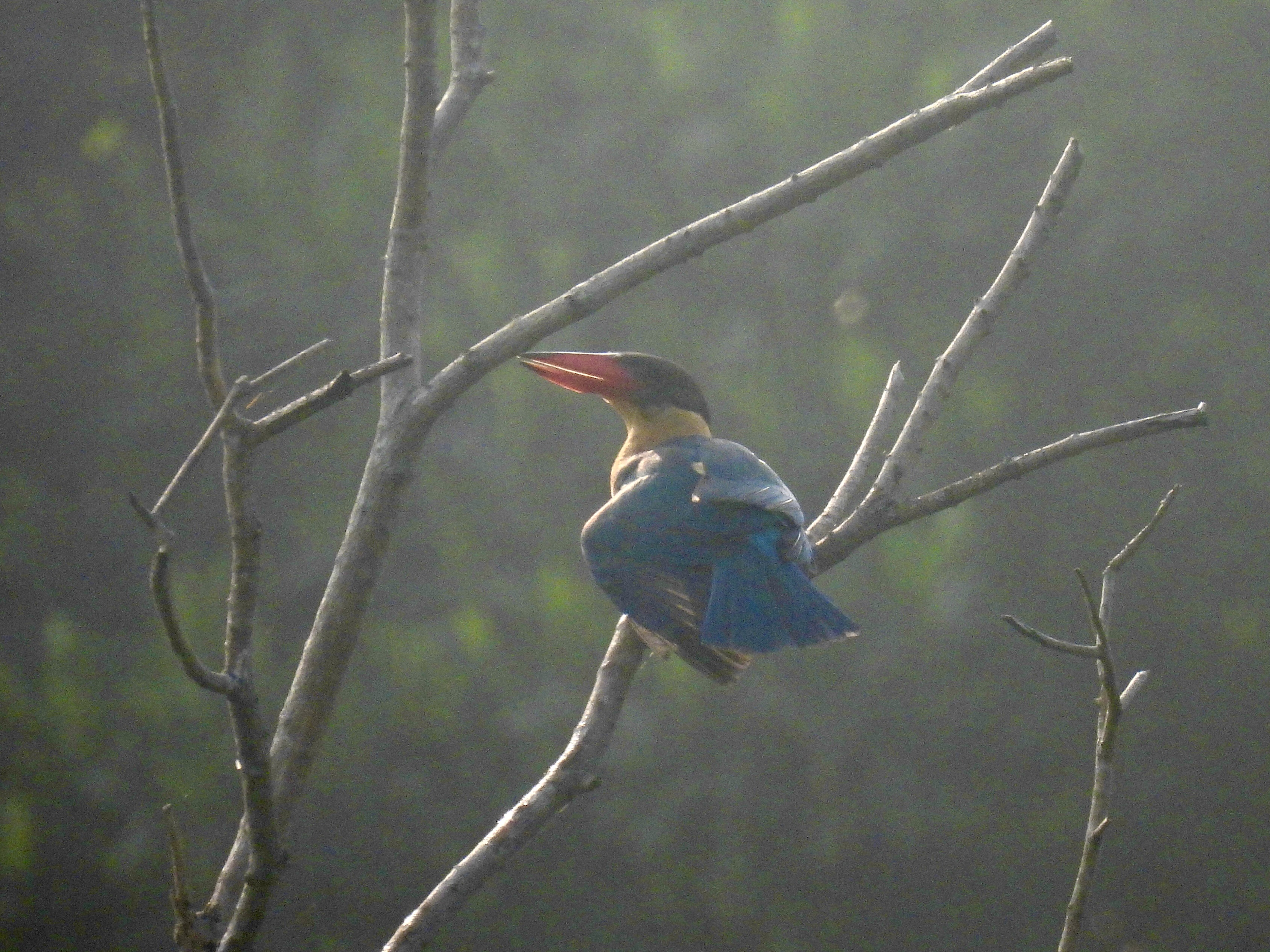

Top Row (left to right in order): House Crow, Pink-Necked Green Pigeon, and Collared Kingfisher
Middle Row: Male and Female Oriental Pied Hornbills (left), White-Throated Kingfisher (top right), and Stork-Billed Kingfisher (bottom right)
Bottom Row: Blue-Tailed Bee-Eater (left), and a swampy pond off the side of the trail that was productive for birding (right)
At around noon, enough people were in line at the ferry terminal that I would be able to pay a normal fare ($4-6 SGD) for a bumboat back to the mainland. After making it back to Changi Village, I ate lunch there and started the long journey home via public transport, arriving back at my apartment just before 3:00pm, a full 24 hours after I initially set off for Pulau Ubin. I could’ve stayed on the island longer, but I had studying to do, the bird activity was dying down in the heat of the day, and exhaustion from the night before was setting in. Plus, I had nailed both of my target species and had an overall very successful and enjoyable outing!
This post and my previous post cover all of my wildlife-watching adventures from the month of October 2024. October has proven a phenomenal month for me in terms of wildlife-watching in Singapore. As I mentioned in my previous post, seeing so much of the city-state’s wildlife in such a short period of time was awesome. However, my pre-university wildlife-watching adventures are just beginning!
This month, November 2024, will be an exciting one for me. I have two upcoming solo, self-sponsored wildlife trips to Indonesia— the first one to Sumatra and the second one to Sulawesi. Both are large Indonesian islands that contain some of the most unique, diverse, and downright spectacular wildlife on Earth!
I hope you enjoyed reading about my October 2024 overnight trip to Pulau Ubin, Singapore. Stay tuned for my upcoming Indonesia posts and thank you for reading as always,
-Bennett
Mammal Species Recorded: (Lifers bolded)
- Greater Mouse-Deer
- Dark-tailed Tree Rat (?)
- Common Palm Civet
- Long-tailed Macaque
- Lesser Short-nosed Fruit Bat
Bird Species Recorded: (Lifers bolded)
- White-rumped Shama
- Stork-billed Kingfisher
- Oriental Pied Hornbill
- White-throated Kingfisher
- Collared Kingfisher
- Common Kingfisher
- Javan Myna
- Pink-necked Green Pigeon
- Common Flameback
- Brahminy Kite
- Blue-tailed Bee-Eater
- Pacific Swallow
- Barn Swallow
- Asian Glossy Starling
- Zebra Dove
- Spotted Dove
- Long-tailed Parakeet
- Large-billed Crow
- House Crow
- Swinhoe’s White-Eye
- Straw-headed Bulbul (heard only)
- Sunda Scops Owl (heard only)
Reptile & Amphibian Species Recorded:
- Banded File Snake
- Oriental Whipsnake
- Green Crested Lizard
- Asian Water Monitor
- Asian House Gecko
- Oriental Garden Lizard


 Bennett Gardner Wildlife Watching
Leave a reply to Bobby Hollis Cancel reply